The Hidden Filters: How to Fix the Biases that Skew Investment Pipelines Away from Women Founders
Over the past decade, the idea of investing with a gender lens has moved from the fringes of impact investing into a more mainstream priority for many investors. One recent estimate places global assets under management in investments with defined gender objectives or criteria at more than US $122 billion, as of early 2025.
A major reason for this uptake is the growing body of evidence linking diversity to stronger financial performance: 2023 McKinsey research shows that companies in the top quartile for board-gender diversity are 27% more likely to achieve above-average profitability than those in the bottom quartile, while BCG found that organizations with above-average management diversity generate 19% more innovation revenue and stronger Earnings Before Interest and Taxes (EBIT) margins. (EBIT is a measure of a company’s operating profitability, calculated as total revenue minus operating expenses.)
As these numbers show, gender diversity isn’t merely a matter of fairness; it can be a strategic lever for innovation, improved risk management and better returns. However, there is a paradox: While the overall gender-lens thesis gains traction, actual representation of women-led businesses remains stubbornly low within venture capital and private investment portfolios.
Blind spots lead to bottlenecks
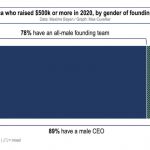
Despite many commitments, pledges and gender-lens investing criteria, many investors continue to struggle with the actual representation of women-led ventures in their portfolios. In 2024, women-only founding teams captured just 2.3% of global VC funding, compared with 83.6% for men-only. Even when funded, women-led startups raised checks that were less than half the size of those raised by men on average — US $5.2 million vs. $11.7 million.
So why does this imbalance persist, even as gender-lens investing moves further toward the mainstream? At LeFil Consulting, through our extensive work with ventures, investors and entrepreneurship support organizations, we’ve found that the heart of the problem isn’t a lack of intent but a lack of measurement. Specifically, many investors do not perform a systematic, data-driven diagnosis of their pipeline across the different stages of the investment funnel. Without tracking gender composition and conversion rates at each stage, investors lack visibility into where imbalances arise and instead rely on assumptions rather than evidence when attempting to address them.
Gender bias is built into every stage of the investment funnel
When applying a diagnostic lens, investors often discover structural and behavioral biases woven into each stage of the investment funnel, acting as a filter that reduces the representation of women-led investees. Though they all contribute to the same end result, bottlenecks in each stage need to be addressed differently.
The very first biases appear during sourcing and pipeline identification. Investors often rely on personal networks, which remain predominantly male, resulting in early-stage deal flow that replicates male-dominated patterns. Meanwhile, women-focused accelerators, associations and referrals remain underutilized, leaving investable, women-led companies off the radar of many funds.
Even when a deal enters the funnel, pre-selection often favors familiar archetypes (e.g., repeat founders) in sectors with predominantly male representation, and profiles typically associated with male-led startups. At this stage, many women-led ventures may be screened out, as they do not fit well into the “traditional mold,” before formal diligence begins.
In the due diligence stage, global behavioral research reveals systematic biases: For instance, women founders are more likely to receive prevention-focused questions (e.g., “how do you plan to retain your current customers?”) while men are more likely to receive promotion-focused questions (e.g., “how do you plan to acquire new customers?”). This influences investors’ perception of growth potential compared to the risk level of a given candidate.
At the decision stage, bodies like investment committees remain heavily male-dominated. For example, globally, women comprise around 22% of investment professionals and only around 10-15% of senior decision-makers. A lack of gender diversity increases the likelihood that decision makers will favor founders with familiar backgrounds and leadership styles, and that they’ll base their decisions on subjective “cultural fit” assessments and a constrained view of what constitutes a strong investment, all of which can disadvantage women-led firms.
Even when an investment is made, the deal terms often reflect gender disparities: Women-led firms typically receive smaller funding rounds and lower valuations. These differences both stem from and reinforce perceptions of higher risk and limited growth potential, leading to a vicious cycle over time.
These findings highlight that biases emerge at multiple stages of the investment funnel. Consequently, improving gender diversity requires a holistic understanding of how these biases affect outcomes. Treating gender as a checkbox, without such a diagnosis, risks failing to address the underlying drivers of underrepresentation.
Solutions depend on identifying the bottleneck
Only once a bottleneck is identified can targeted action follow. But a “one-size-fits-all” fix won’t work. The right intervention depends on the specific stage at which the funnel imbalance exists. Here are a few practical steps and recommendations on how investors can correct their course at each stage of the investing process.
Pipeline identification:
- Signal inclusion in communication materials: Revisit the language, imagery and values conveyed in your communication (e.g., your website, pitch decks and outreach documents). Ensure that you explicitly welcome women‐founders and that your calls for applications and investor–founder communications use accessible, collaborative language (avoiding overly technical or skewed framing that may deter non-traditional entrants).
- Diversify sourcing channels: Expand beyond traditional male-dominated referral networks. Partner with accelerators, incubators or ecosystem organizations known for strong representation of women founders.
- Track which channel works best, for what type of applicants: Log the gender breakdown of sourced deals by channel, and by both founder gender and team composition, and monitor how they convert to pre-selection.
Pipeline pre-selection:
- Set transparent criteria: Define evidence-based, standardized pre-selection criteria that reduce subjective judgments and make evaluation more consistent.
- Diversify reviewer teams: Aim for gender parity (or near parity) in review teams; train reviewers on unconscious bias; pilot anonymized or masked applications where feasible.
- Simplify application burdens: Review whether any requirements create undue barriers for smaller or women-led companies; reduce documentation where possible.
Due diligence:
- Revisit thresholds and metrics: Ask whether your typical metrics and benchmarks (such as scale, historic traction or sector) disadvantage women-led firms; consider alternative pathways, smaller ticket thresholds or adjacent metrics.
- Standardize information requests: Provide templates or guided forms for founders to submit materials, with clear guidance on expectations and examples of strong submissions; consider offering optional pre-submission feedback.
- Train diligence teams on framing: Educate teams about prevention- vs. promotion-focused questioning and ensure they balance both types of inquiry; review due diligence reporting for gendered language or framing.
- Track conversion by gender: At the end of diligence, record how many women-led deals were presented versus how many advanced to the investment committee for decision, and identify the “drop-off” rate and key reasons for it.
Investee selection:
- Apply consistent scoring frameworks: Develop and use standardized scoring tools that integrate both financial/operational metrics and softer factors — e.g., values, team management and diversity — ensuring all deals are scored on the same basis.
- Revisit composition of investment committees: Increase gender diversity on the committee; provide unconscious-bias training; rotate membership to avoid homogeneity of perspective.
- Audit outcomes: Every quarter, track deal conversion rates, average deal sizes and other support provided by founder-gender; use these metrics to identify systemic skews and adjust pipeline practices accordingly.
- Set visible targets: Instead of vague commitments, set measurable gender-balance targets at the selection stage (e.g., “X% of our new portfolio companies will be women-led or gender-diverse teams”) and publicly report progress.
Deal structuring:
- Engage founders in designing the terms of their deals: Host “terms-design” focus groups with women-led ventures to identify structuring or contractual elements that act as deterrents or constraints.
- Simplify documentation: Work with legal counsel to streamline term sheets and contracts, clarify language, remove onerous clauses and make the overall process more accessible for founders without formal legal support.
- Tailor structures where needed: Consider smaller ticket sizes, revenue-based repayment or milestone-linked tranches for women-led firms; integrate gender-inclusive targets (e.g., women in senior leadership, gender-segmented customer metrics) into performance or follow-on investment triggers.
- Track financial and non-financial support provided: Monitor whether women-led portfolio companies receive equivalent funding, access to networks, mentorship and follow-on deals; these are often overlooked and can make a material difference in outcomes.
When investors embed a gender-sensitive lens into the pipeline and selection processes, rather than treating gender as a compliance add-on, they can unlock both fairness and performance. Measurement is the gateway: By tracking gender-disaggregated data across each pipeline funnel stage, investors can transform intention into action, unseen bias into visible bottlenecks and lost opportunities into tangible value.
In the end, gender-sensitive investing isn’t just about investing “in women.” It is about investing smarter and in better portfolios by understanding where the pipeline funnel breaks — and designing processes that deliver equitable access and competitive returns.
Michal Januszewski is a Senior Consultant at LeFil Consulting, a boutique consultancy supporting social enterprises in emerging markets.
Photo credit: Jacob Wackerhausen
You May Also Be Interested In:


- Categories
- Investing