Is the World Bank to Blame for the Cambodian Microfinance Crisis?
For the past five years, Cambodia’s microfinance sector has been experiencing a major crisis. Over-indebted borrowers have been selling land, taking children out of school, and in some cases taking their own lives.
Sadly, this was a crisis foretold.
In July 2016, Cambodia’s microfinance industry convened an all-day event: “Let’s Talk about Over-indebtedness, Now!”. The microfinance CEOs and investors in attendance heard presentations from multiple analysts, including economists from the International Monetary Fund, all of whom conveyed the same message: The sector’s growth had to slow.
That same month, the International Finance Corporation (IFC), the World Bank’s private investment arm, arranged a $90 million loan and gave its “Stamp of Approval” to PRASAC, the largest and fastest-growing of Cambodia’s leading microfinance institutions (MFIs).
After a decade of escalating growth across the sector — along with escalating cases of over-indebtedness, as documented by Cambodian civil-society groups and international human-rights organizations — IFC’s watchdog, the Compliance Advisor Ombudsman (CAO) published its own findings in June 2026. Its two-year investigation concluded that not only had clients been harmed, but that this harm was related to IFC’s failure to identify and monitor the social risks created by its investments. In its response, IFC’s Board of Executive Directors acknowledged that borrowers had been harmed. But in an unprecedented move, it rejected the Ombudsman’s findings, siding with management’s argument that the harms suffered by borrowers aren’t covered by IFC’s Policy on Environmental and Social Sustainability.
In other words, the Board didn’t say the CAO’s findings were wrong — it simply found them irrelevant.
I was directly involved in several of these events: I spoke at the July 2016 industry meeting on over-indebtedness, sharing the findings from my MIMOSA report on market saturation. I later helped draft the Lending Guidelines discussed below, and subsequently served as an external advisor to the CAO during its Cambodia investigation.
In that work, I’ve noticed a gap in the debate over who is to blame. Client advocates point to the failings of the sector at large, which are real. Sector institutions point to their efforts to strengthen client protection, which are also real. But neither side has explained how the sector went off the rails, or who drove it there. And in a world where everyone is guilty, nobody is.
As with most financial crises, Cambodia’s wasn’t caused by any one entity. But some actors bear far more of the blame than others, and IFC stands out: Its role was not only integral to the crisis — it helped undermine the sector’s own efforts to avert it.
Early Warnings of an Overheating Sector
Half a year before my 2016 MIMOSA report placed Cambodia among the most credit-saturated microfinance markets in the world and explicitly warned that the sector had to slow, the International Monetary Fund’s November 2015 report called on Cambodia’s authorities “to address growing financial stability risks by stabilizing and moderating the pace of credit growth to more reasonable levels.”
Cambodia’s central bank didn’t act on that advice. Its one notable regulatory response — an interest-rate cap in 2017 — failed to slow growth, and it fell to others to fill the gap.
In December 2016, the Cambodian Microfinance Association published its Lending Guidelines, which set explicit limits on the practices most likely to deepen over-indebtedness. These limits initially focused on reducing additional lending to borrowers who were already carrying several loans, and later extended to the practice of early refinancing into substantially larger loans. The Guidelines had no legal enforcement behind them: Compliance ultimately rested only on the willingness of microfinance lenders to follow them. But they did feature a monthly dashboard, produced by the Credit Bureau of Cambodia, that showed each lender’s standing against the Guidelines and against its peers. It was exactly the kind of independent monitoring that interested investors could easily use to track their investees’ compliance — and its existence was widely known among microfinance investors, many of whom had also endorsed the Guidelines.
There was also another set of actors who relied on the Lending Guidelines: the sector’s Client Protection Certification system, along with the rating agencies that conducted these certifications. To receive and maintain certification, Cambodian microfinance lenders had to show that they were compliant with the Guidelines.
The link between excessive credit growth and over-indebtedness is indirect, but it is not especially complicated. Think of credit as water in a lake and lending safeguards — such as the Lending Guidelines and Client Protection Certification — as the dam that holds back the water. Well-designed safeguards can ensure a steady flow, enabling small businesses to invest productively and helping households to manage their cash flows. But even the best-designed ones will be overwhelmed by an excessive supply of credit, drowning large numbers of clients in debt that they cannot afford. And just as a dam fails when its reinforcements break, the system fails when lenders — especially the largest ones — stop observing the rules and respecting the safeguards. In Cambodia, both of these things happened: The largest lender broke ranks, and the water kept rising.
The Dangers of Growth at All Costs
 In 2015, the largest microfinance institution in Cambodia was PRASAC, nearly double the size of its nearest rival. Founded in 1995 as a rural development project and later transformed into a for-profit company, it was also the fastest-growing among Cambodia’s leading MFIs, averaging growth of 46% from 2008 to 2015, compared to 35% for the rest of the microfinance sector (according to my calculations, based on data from the Cambodian Microfinance Association and PRASAC). IFC got behind PRASAC in the early 2010s, lending it $35 million between 2012 and 2015, and arranging a $90 million syndicated loan in 2016, with $20 million from its own account and another $70 million drawn from private lenders. The loan was meant to “support [PRASAC’s] further growth in the market” and to leverage IFC’s “Stamp of Approval” to help it “establish relationships with international banks and obtain investors’ validation of the Company’s business model.”
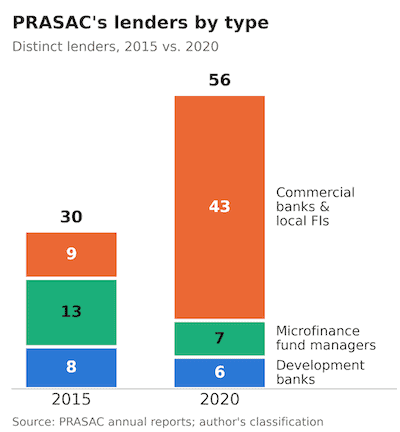
That $90 million was only about a quarter of PRASAC’s borrowings at the time, but IFC’s endorsement mattered more than its money. In 2015, PRASAC’s lenders included eight development finance institutions, 13 microfinance fund managers and nine commercial lenders. By 2020, its commercial lenders had grown to 43 — mostly Asian banks — while its number of microfinance lenders had nearly halved. By its own stated objectives, IFC’s loan was a success.
The immediate period after that IFC loan saw another key development. In March 2017 a Sri Lankan financial conglomerate that already held a minority stake took control of PRASAC and pushed its growth even higher: Its growth rate hit 50% that same year, compared to 22% for the rest of the microfinance sector. That was also PRASAC’s first full year operating with the Lending Guidelines in effect, which it violated repeatedly, leading to the withdrawal of its Client Protection Certification in November 2018. Whatever the effects PRASAC experienced from that loss of certification, they weren’t financial; commercial lenders kept arriving, and in 2020, the company was sold for $603 million — netting the owner a 121% return in three years.
The problem with PRASAC wasn’t the entry of Asian banks, it was the growth they were funding. In 2016, I warned that without enforceable rules, “lenders seeking to slow down on their own will simply see their market positions replaced by more aggressive competitors — a particularly vicious competitive dynamic that rewards short-term gains and undermines long-term sustainability.” Here the aggressor turned out to be the largest MFI in the market, carrying IFC’s imprimatur, and pursuing precisely the short-term growth my report had warned about.
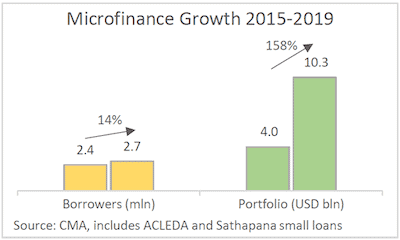 Having watched PRASAC grow at double the pace of the rest of the sector in 2017, its competitors soon followed: They averaged 30% annual growth from 2018 to 2019. The Lending Guidelines had been cast aside, and the warnings to slow growth had been ignored. Worse yet, even as MFI portfolios exploded, the number of Cambodian clients served by microfinance institutions barely budged. Growth was driven almost entirely by increasing the amounts lent to clients, many of whose incomes weren’t keeping up.
This is how financial crises unfold.
By 2022, when the CAO complaint was filed, Cambodia was the third most credit-saturated country in the world. And by 2023, the average microfinance loan had grown to $4,578, up from $409 in 2006 — a jump from 67% of per capita GDP to 188%.
An Incoherent Microfinance Strategy
Key to understanding IFC’s actions during this period is the disconnect between its two arms: Advisory Services and Investment Services.
IFC’s advisory arm has worked since 2008 to build the infrastructure a responsible market needs: It supported the creation of the Credit Bureau of Cambodia (launched in 2012), backed the Lending Guidelines, and helped establish the Client Protection Certification system. By IFC’s own account, its work with Cambodia’s regulator and industry associations aimed “to reduce the risks of overheating of the credit market and over-indebtedness.” These are real actions with real value, which came at a time when IFC’s advisory arm was already identifying the risks building in Cambodia. In July 2015 it published a report warning that pressure from competitors could push Cambodian lenders into “sub-prime” lending — “the type of competitive pressure that … led to the catastrophic financial crisis in 2007.”
A year later, IFC’s investment arm gave a key boost to the largest and fastest-growing of Cambodia’s leading microfinance institutions, which was looking to grow still more — on the heels of multiple warnings that growth was the key driver of over-indebtedness risk in Cambodia. When PRASAC failed to abide by the sector’s own Lending Guidelines and had its Client Protection Certification withdrawn, IFC’s investment arm took no action — despite the fact that IFC had the means to exercise oversight even after the loan had been made, since it “incorporates affirmative covenants in its legal agreements requiring its microfinance institution clients to maintain … procedures and controls for responsible finance and consumer protection.” Inaction in the face of wrongdoing is a form of silent consent, and its 2016 loan to PRASAC closed out only in October 2020, well after the damage had been done.
What’s the point of creating a client protection infrastructure if IFC’s own investment arm supports its largest violator? It’s incoherent.
The only way to understand that incoherence is to recognize that IFC’s two arms — advisory and investment — are acting like two distinct organizations, guided by their own separate objectives. While the former works on protecting clients, the latter pursues growth, with client protection at best an afterthought. And when forced to defend its actions, IFC combines the two activities: Statements like “IFC’s clients in Cambodia have reached more than 400,000 microenterprises and 1.7 million farmers” sit alongside a laundry list of client protection efforts. At no point does IFC recognize that in Cambodia, its two objectives, growth and client protection, have been working at cross-purposes since at least 2016.
The Accountability Gap
After its own Ombudsman found that IFC failed to ensure that the clients of its investees were protected from harm, IFC didn’t respond by acknowledging the failures that led to this point and rethinking its strategy. It simply stated that the findings are not applicable. The CAO’s head, Janine Ferretti, resigned the very next day.
Less than two weeks later, the Board went further, directing the CAO to “suspend processing of the ongoing CAO cases” and to “not take any cases relating to Financial Consumer Protection in microfinance.” This stance isn’t just about Cambodia: Concerns are growing that the decision sets a dangerous precedent that will reduce the World Bank’s accountability and even influence other development banks. Worse yet, whatever accountability may have been sparked by borrower complaints to the CAO has now been deferred until the completion of IFC’s Sustainability Framework review process — that is to say, until late 2028 at the earliest. In the interim, IFC’s only customer complaints channel remains closed to microfinance borrowers.
There are multiple experts and advocates calling for IFC to completely rethink its approach to protecting microfinance clients. IFC would do well to consider them. However, for any reforms to work, it must first acknowledge the serious errors it has committed along the way. That’s what accountability means.
Unfortunately, IFC’s approach to accountability remains as incoherent as its microfinance strategy. In its management response to the CAO’s findings, this incoherence is on full display: It calls for more work on market infrastructure, more training, and more hotlines and working groups from its advisory arm, and for tighter due diligence and supervision of its investees from its investment arm. But at no point does IFC make any link between the two — or any commitment that its investments will be bound by the very safeguards its advisory arm helps build.
Its Board has, however, sent one clear signal: This incoherence is set to continue. Twelve days after promising to fund a financial ombudsman in Cambodia, it silenced its own.
Daniel Rozas is an inclusive finance consultant focusing on client protection, and co-founder of the MIMOSA Project, which tracks market saturation in microfinance.
Photo credit: patpitchaya
You May Also Be Interested In: