Missing the Exit: The Growing Need for New Exit Pathways in Agriculture Investing
Exits make the wheel of impact investing go around. And right now that wheel is not turning, particularly in smallholder agriculture in Africa. Exits offer companies the opportunity to grow and sustain their operations, while also allowing investors to recycle returned capital into other impactful solutions. Without them, companies will be locked into a permanent, fruitless search for affordable capital, and impact investors might as well just give grants. This is why the stark lack of equity exits to date in smallholder agriculture should compel impact investors to take action.
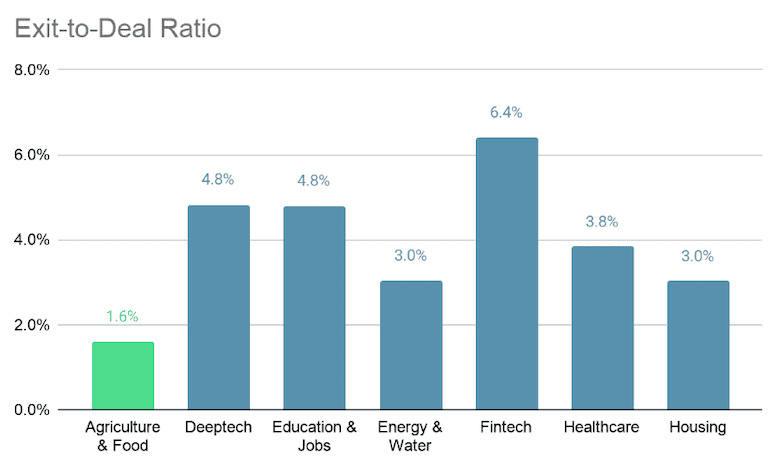
According to Africa: The Big Deal – Startup Deals Database, a database listing funding deals secured by startups in Africa, since 2019, there were 208 equity exits across the continent. And while agriculture made up 10% of investment flow (436 out of 4,173 deals), it accounted for just 3% of exits (seven out of 208). To put it another way, for every 62 announced ag deals, there has been one ag exit. In comparison, the energy and water sector saw one exit for every 33 deals, while fintech saw one exit for every 16 deals. The chart below shows the ratio of exit to deals for each sector, expressed as a percentage. Agriculture has, by this measure, the lowest ratio of any sector in Africa.
It’s not just the lack of a steady flow of exits that raises a red flag. A healthy investment ecosystem is also characterized by a mix of exit types — including strategic acquisitions, initial public offerings (IPOs) and secondary transactions — at consistent or rising multiples that create reasonable returns. In US venture capital, according to Pitchbook’s VC Exit data, 38% of exits in 2025 came via acquisitions, 33% via IPOs, and the remaining 29% from secondary sales of shares in private companies: a nice, healthy mix.
In agriculture, we see much more concentration. According to Pitchbook, 23 out of 26 exits in smallholder agriculture across emerging markets were via merger and acquisition (M&A). The remaining three were via two buyouts and one IPO. That overreliance on M&A decreases both the likelihood of an exit (since there are only so many acquirers out there), as well as the value returned from those exits (since acquirers are well aware that companies do not have many other options available).
Impact investors are at a crossroads, with two possible paths before us. On one path, investors simply stay the course, maintaining the hope that big exits for smallholder-focused agri-SMEs are around the corner, and that when these exits finally come they will enable companies that are achieving rapid scale to proceed through the traditional venture capital and commercial market routes.
The other, less-traveled road requires us, as investors, to build the exit pathways that we’ve been hoping for. Taking this path would be more difficult, but it would give us the freedom to explore exit strategies that are more appropriate for early-stage companies that work directly with smallholder farmers, while strengthening their resilience and improving their livelihoods.
Rather than continuing to operate under existing market structures, emerging models, such as impact secondary funds and impact buybacks, show that there are still untapped opportunities for impact investors to build innovative funding solutions that are better suited for smallholder-focused agri-SMEs. In the article below, I’ll discuss the challenges of achieving exits in smallholder-focused agriculture, highlighting the limitations of current investing models and exploring some of these emerging alternatives.
A trickle of exits, rather than a steady stream
According to Africa: The Big Deal – Startup Deals Database, between 2019 and 2025, 74 of the 208 equity exits (36%) from companies across Africa were in fintech, while only seven were in agriculture. Four of these companies were grocery delivery platforms, two were dinner kit/meal plans, one operated in the food and beverage sector, and one was a seed potato farm. None of these companies demonstrated a focus on smallholder farmers.
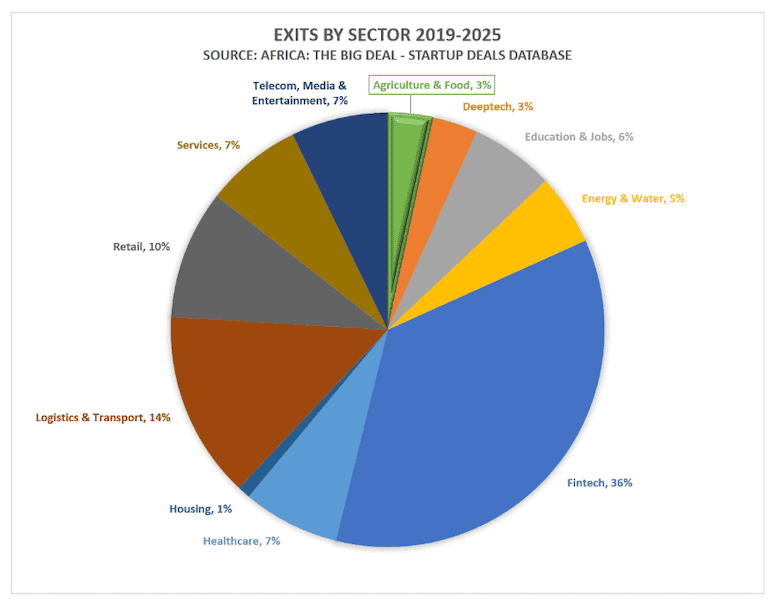
Cross-checking this with data from Pitchbook, since 2006, there have been 385 exits in the agriculture industry across East Africa, West Africa, India and Latin America. Yet agriculture comprised only 4% of exit deal flow, while sectors like financial services (35%), healthcare (20%) and energy (16%) dominated. Of these agriculture exits, only 72 companies had a focus on smallholder farmers. Compare that number to over 2,500 and 1,500 exits in financial services and healthcare, respectively.
The exits we have seen in smallholder agriculture can make it tempting to believe that more exits are coming, but these few successful cases do not necessarily demonstrate scalable or replicable exit solutions. Mercy Corps Ventures, for example, saw successful exits or partial exits from its investments in Pula, Umoja and Topl. Pula is a microinsurance firm serving over 20 million farmers across 22 countries in Africa, Latin America and Asia. Umoja provides Web3-native hedging solutions for currency and other financial risk assets. Topl’s blockchain solution links smallholder farmers with value-add service providers, like weather information, insurers, lenders and input providers. In addition to these heavy tech play companies, recent years have also seen Truvalu’s exit from GrowPact and Pamoja Farms’ full acquisition of Ten Senses Africa.
But while these examples are promising indicators of the potential of agri-SMEs, they are the exception rather than the norm. The common challenges of working in agriculture help to explain why there have been such sporadic and limited exits to date.
The unique challenges of exits in agriculture
Agriculture is a notoriously difficult sector to invest in, given the asset-heavy nature of the companies, alongside their mostly low margins, and long research and development, sales, and cash conversion cycles. ISF Advisors found that offtakers sourcing from smallholders, like traders and processors, often lend to these farmers at a loss, hoping to either secure farmer harvests, or help enable greater productivity or other impacts. These losses are driven by low loan pricing, high cost of funds, and a high cost of risk when a climate shock hits: Offtakers’ lending losses increase from 13% when farmers don’t face any climate shocks, to 42% if a shock occurs. Businesses within the sector must also deal with a wide range of value chains, perishability of their primary goods, slow farmer adoption of new practices, and susceptibility to climate change and seasonal variations. One of Acumen’s portfolio companies, Kentaste, experienced this firsthand back in 2021-2023, when a two year drought significantly impacted the coconut harvest, with supply falling by 38%. The impact of climate change, combined with its debt obligations, led to a drastic shift in the company’s unit economics.
In addition to the economics of agribusinesses, the operational complexity of these companies’ business models requires Patient Capital and more creative financing. For example, vertically-integrated models — wherein a smallholder-focused company offers farmers a combination of inputs, hands-on training and direct market access — demand precise coordination. These companies often need to establish regional hubs where trained agents have the resources to pay farmers, aggregate and store product, and deliver or process the raw material on time. Typical investment products and timelines are usually not suitable for their needs.
Agriculture needs both debt and equity
Considering the factors laid out above, it’s reasonable to wonder whether or not equity is the right tool for investing in agriculture. If debt can reliably get investors their money back and still help agribusinesses achieve their objectives, why continue to invest equity?
It’s because, as Acumen has seen, equity capital can be catalytic for early-stage agri-SMEs.
Equity is appropriate for companies that demonstrate significant revenue growth and potential to scale. From Acumen’s own equity portfolio, S4S Technologies — which sells solar dryers to dehydrate fruits and vegetables, restoring the value of smallholders’ rejected produce — more than doubled its revenues two years after our initial investment. Equity capital plays a role in a blended instruments approach that can provide critical support to agri-SMEs that serve smallholders, while also being pragmatic about investors’ liquidity needs. Impact investors want to support the needs and work of agri-SMEs, but they also need to see some level of return on their investments. Ensuring that companies have a healthy mix of debt and equity can help achieve both.
I spoke with two agriculture impact investors to get their thoughts on why we should continue to invest equity and not just debt into agri-SMEs. According to Tamer El-Raghy, Managing Director of the Acumen Resilient Agriculture Fund, Acumen’s later-stage agriculture investment initiative, “Companies require equity to maintain a healthy balance sheet. Excessive debt can lead to over-leveraging, substantially elevating the risk of survival during both macroeconomic and microeconomic fluctuations.” Similarly, Chris Isaac of AgDevCo stated, “For early-stage agri enterprises, equity is essential as a buffer for inevitable shocks. Relying on senior debt only is high risk, because a bad season or a market shock could knock you off course.”
Equity still plays a critical role in scaling agri-SMEs, and so the need for more potential exit pathways remains.
Current exit approaches are limited for impact investors in agriculture
We believe that impact investors cannot continue on their current path, hoping that agriculture exits are just around the corner and believing that traditional financial structures can sufficiently serve the needs of smallholder-focused agri-SMEs. That long-expected increase in exits will never arrive as long as these exits continue to occur on a one-off, sporadic basis, with both investors and entrepreneurs tasked with identifying potential buyers.
Common exit strategies in Africa involve one of three routes: strategic acquisition, a secondary sale, or management buybacks. AVCA’s 2025 African Private Capital Activity Report found that 38% of exits across sectors were sales to strategic buyers, followed by secondary sale transactions at 26% and management buybacks at 19%. But while these are feasible strategies, there are limitations to each.
In agriculture, local and multinational corporations are often considered the most likely strategic buyers. However, corporate expectations around investment and scale can make it challenging to pitch a smallholder-focused company.
One example is Olam, one of the largest commodity trading firms in the world. Olam had previously backed a digital farmer services platform, Jiva Ag, but ultimately closed the company “in light of the expected continuing investment required to sustain its operations in these challenging times and difficult market conditions.”
Similarly, when Acumen asked another large multinational corporation about their level of interest in acquiring or investing in agri-SMEs, they expressed their hesitations: “We would partner with an ‘ESG’ company in a heartbeat. It’s a nice story. But it’s a different story of wanting to invest. Is there a financial ROI? Is there AI? How would a[n investment] partnership make our unit economics more favorable?” Given these concerns, a smallholder agri-SME would need to achieve significant scale, volume and profitability to be attractive to a large corporation.
In the case of management buybacks, three things need to happen: First, the company needs to generate enough cash that a buyback is even an option, and buying back shares needs to be seen as a reasonable use of this cash, which likely means the company needs to be intensely profitable and/or have reached a slower-growth steady state. Additionally, the company must have decided to not raise significant amounts of additional equity, which would counteract their repurchasing of company shares.
Finally, when it comes to secondary sales, a lack of buyers makes this a rare option. A key barrier here is the unwillingness of development finance institutions (DFIs) and multinational development banks (MDBs) (which provide much of the capital to potential acquirers) to support secondary transactions. As a recent report from Third Way Capital, sponsored by British International Investment (BII), said: [DFIs’] mandates emphasise primary capital deployment and [their] impact frameworks include a use of proceeds lens, which often excludes transactions that buy out existing investors rather than deploying capital into new assets.”
However, a 2024 sale of BII assets to Blue Earth Capital is a hopeful sign. More openness to these types of vehicles among DFIs and MDBs is essential to building the kinds of consistent and appropriate exit pathways that are ripe for exploration in agriculture.
We need to start building alternative, more appropriate exit pathways
In response to these challenges, alternative ideas and vehicles are beginning to emerge and take shape in the agriculture sector. These include:
- Impact secondary buyers, such as Blue Earth Capital and Coller Capital, which offer exit opportunities for impact investors.
- Approaches like Planetary Impact Ventures’ evergreen capital structure with no carried interest, which enables individual investors to exit after five years while the fund continues.
- Entities like Africa Eats, which foregoes exit expectations altogether via an impact holding company modeled after Berkshire Hathaway.
- Impact buybacks, another sustainable exit pathway wherein a company buys back investor shares by meeting impact milestones.
- Revenue-based buybacks, which could create a more financially feasible alternative for companies by allowing them to buy out investor stakes over time based on the revenue they’ve generated.
- Employee ownership models, as explored extensively by Transform Finance and the Predistribution Initiative, which have been primarily based in the United States but offer room for further research and application in emerging markets.
There are certainly more questions than answers when it comes to exploring these alternative pathways: Where will the capital come from and how can investors raise it? What kind of fund structure would be needed to deploy them? What happens to the companies and their capital needs once a secondary buyer or evergreen holding company invests? What would it take for investors to be willing to accept impact milestones as a way for companies to buy back investor shares?
Unlike the current exit pathways that are common across the sector, these solutions are more financially feasible for small agri-SMEs, and some of them — particularly impact secondary buyers and holding companies — have potential to scale. If these practices received wider uptake, investors and companies alike would not need to keep searching or hoping for the next buyer.
The path where we wait for traditional exits to happen and solely seek investments that fit existing market structures leads to nowhere. The growth, return and timeframe expectations of traditional market structures were not designed with smallholder farmers or climate resilience in mind. It’s time for us to start forging the less-traveled path.
What other exit pathways are out there? We’d love to hear about other ideas and solutions that you’ve heard about or are interested in exploring. Share your thoughts with us here.
Coco Lim is Manager of Insights at Acumen.
Photo credit: Peter Irungu for Acumen
You May Also Be Interested In:


- Categories
- Agriculture, Investing