Context Instead of Carbon: Why Climate Finance in Africa Must Shift its Focus from Mitigation to Adaptation
Global climate action has long been framed through a binary lens: There’s mitigation, which seeks to cut or absorb greenhouse gas emissions, and adaptation, which helps communities cope with the impacts of a changing climate. This framework shapes how funding flows, how projects are designed and even how “success” is measured.
It is a framework that makes sense in boardrooms and at international climate summits. But on Africa’s farms, in its schools and across its villages, it simply does not fit. For Africa, which contributes less than 4% of global emissions yet experiences some of the world’s most severe climate shocks, this binary does not just misalign priorities, it misdirects investment. For instance, Africa is often treated as a convenient supplier of carbon credits for high-emitting countries, its forests, soils and clean-cooking projects turned into tools that allow others to meet their emissions targets while the continent’s own urgent adaptation needs remain underfunded.
For most African farmers, the central question is not how to offset emissions elsewhere, it is how to ensure the next harvest survives.
When Climate Finance Follows Carbon Instead of Context
This framing matters because it determines where climate finance goes.
Mitigation attracts the bulk of funding because it produces measurable carbon outcomes, plugs neatly into carbon markets, and offers global benefits to high-emitting countries trying to meet their net-zero targets.
Adaptation, by contrast, delivers local benefits, protecting communities from drought, floods and crop failures — but it is harder to quantify, commodify or sell. Unsurprisingly, only about 15% of global climate finance currently goes to adaptation, and less than 3% reaches local communities.
This imbalance carries profound consequences. It risks turning African landscapes into carbon farms for the Global North, designed more to meet external offset targets than to strengthen local resilience. It also obscures the real opportunity: Many of Africa’s most climate-smart practices are also its most economically promising. The problem is not that these solutions do not exist, it is that the current financing architecture does not recognise or reward them.
Why the Mitigation vs. Adaptation Divide Breaks Down on the Ground
In my work with Kuza, a B-Corp social enterprise that supports 1.2 million farmers through a network of more than 6,000 youth agripreneurs across seven African countries, we see this every day. Farmers do not choose practices because they are labelled “mitigation” or “adaptation” or “regeneration.” They choose them because they solve immediate problems: erratic rainfall, declining soil fertility, food insecurity and rising costs.
Many of these locally rooted solutions deliver both mitigation and adaptation benefits, even though they rarely fit into neat carbon metrics. For example:
- Mulching helps crops survive drought while increasing soil carbon.
- Zai pits (small planting basins that collect rainwater and concentrate organic matter) capture scarce rainwater, improve soil biology, and make it possible to grow even water-intensive crops like arrowroot (nduma) in drylands.
- Cover crops protect soil from heat and erosion, improve fertility and water retention, and build organic matter that strengthens resilience while helping farmers reduce input costs.
Many of these adaptation practices are also inherently regenerative because they rebuild soil, conserve water and strengthen long-term resilience. These are context-specific, low-cost practices that can be chosen based on soil type, water availability, land size and household priorities. They are difficult to package into carbon offset reports, but they are indispensable to Africa’s food systems and rural economies. What looks like subsistence-level adaption in donor reports is, in practice, the seed of scalable industries.
These adaptation practices are also the foundation for new industries. Climate-resilient and underutilised crops like millet, amaranth (terere) and cassava are naturally gluten-free and nutrient-dense. They offer a base for value addition, as they can be processed into high-margin products: flours for health-conscious urban consumers, plant-based snacks, fortified porridges and bio-based packaging materials. Yet they remain stuck in low-value local markets, unable to attract capital due to demand and functionality gaps (e.g., consumer habits and the need to reformulate gluten-free crops to enable effective food processing).
If the global climate system continues to channel money based on carbon metrics rather than local context, Africa could miss the chance to transform its climate-smart practices into competitive, job-creating industries.
Climate-Smart Is Bankable
To work for Africa, climate action must shift from a charity lens to a market lens, seeing climate-smart practices not just as survival strategies, but as the foundation of future growth.
This requires aligning finance with practices that secure resilience now and reduce emissions over time, even when the gains are harder to measure. It means building a new model of green growth where climate-smart becomes business-smart.
To that end, I see three priorities:
First, enable green demand. Government policies must reward sustainable production, rather than subsidising inputs. Imagine large African or international baked goods corporations committing to source gluten-free flours from climate-smart cassava or amaranth farmers, or food processors paying a premium for potatoes grown with zai pits and compost to conserve water and improve soil. Reliable buyers would make these practices viable for smallholders.
Second, accelerate climate-resilient production. We need to scale proven techniques like zai pits, raised beds, intercropping and drought-tolerant seeds through trusted local channels. At Kuza, we work with youth agripreneurs — each embedded in their communities and equipped with portable digital toolkits — who train and support over 200 farmers each. This “phygital” model combines local trust with bite-sized video training on over 60 regenerative practices, from mulching to solar drying, and has already reached over 600,000 farmers.
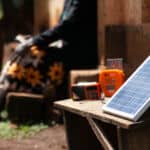
Third, power green value addition. The biggest post-harvest losses, which according to FAO estimates amount to up to 30-50% in some value chains, happen not on farms but after harvest. Solar-powered dryers, cold rooms and milling units can convert surplus crops into shelf-stable products, cut emissions from waste and create rural jobs. We are seeing this in banana and potato value chains, where even small cooperatives are using solar dryers to produce high-value flour and chips.
The Investable Case: Returns, Savings, Scale
Africa’s climate-smart practices are not just a “feel-good” story: They are cash-flow positive, investable opportunities. Across six major value chains in Kenya, the farmers Kuza trained on climate-smart practices show very high willingness to adopt (around 80–90%). The resulting improvements in yields, quality and income are often significant enough to give investors a clear business case for supporting adaptation.
Here are examples of the unit economics for four common agricultural products, showing the financial impact of climate-smart practices on individual farmers per year:
- Potato: Using certified seed + basic soil/water practices (e.g., ridging, mulching) can generate an additional $275, from higher yields and quality, and lower loss.
- Poultry: Improved, ventilated housing + hygiene/feeding routines can generate an additional $115 from lower mortality, better feed conversion and steadier output.
- Dairy: Structured breeding + fodder/forage management (e.g., using fodder shrubs as a supplement to existing feed), along with cut-and-carry (i.e., growing forage, cutting it and bringing it to the cow instead of grazing) can generate an additional $125 from improved productivity.
- Tomato: Raised beds + mulching + integrated pest management + simple irrigation on ~0.25 acres can generate an additional $625 from better agronomy and marketable quality.
These gains are realised when farmers combine simple climate-smart practices with small, practical investments: for example, basic irrigation kits, low-cost housing upgrades, or raised beds and mulching supported by improved seed. These strengthen productivity and reduce losses, so most farmers begin to see improvements within one to three crop cycles — and even faster where reliable markets are in place. These practices can also help facilitate the diversification of farming products: Agriculture always carries climate and pest risks, and returns are more stable when farmers have a mix of crops or livestock rather than relying on only one (something farmers already tend to do).
Portfolio Scale
According to Kuza’s modeling, among tens of thousands of willing adopters across counties, the aggregate income lift from these small upgrades would exceed $25 million per year, before value addition or the higher prices that climate-friendly, traceable produce can command in the market. The addressable market is far larger: To take one example, Kenya has registered ~6.5 million farmers in a national farmer registry, creating a clear pathway to scale targeting.
Why Processors Care (and Should Co-finance)
Kenya’s food processors often run at around 40% capacity because they cannot secure consistent, quality raw material at viable prices. Investing in key climate-smart practices upstream — such as certified seed, irrigation or basic on-farm storage — helps processors raise throughput, stabilise product specifications, cut rejects and reduce procurement volatility. This is not philanthropy; it is a form of supply-chain investment that many processors already use in contract farming or input-credit models.
Crucially, investing in farmers also builds trust and long-term relationships that translate into better quality and stronger traceability in an increasingly discerning market. It is, in practice, a simple investment in a more reliable supply base, one that helps processors keep their factories running closer to full capacity.
What to Finance (and How)
Climate-smart practices need upfront investment, making blended finance essential. Philanthropy can de-risk early adoption; once results are proven, private capital can scale. Engaging buyers and processors early anchors demand and lowers risk across the value chain. Some examples include:
- Offtake–linked working capital: This provides farmers with the improved seed and essential inputs they need to meet a buyer’s yield and quality requirements. These inputs are supplied upfront, and the cost is recovered when the farmer delivers to the off-taker, making it low-risk and easy for farmers to adopt.
- 12–24-month small asset loans: These enable farmers to acquire practical tools, such as poultry housing kits, small drip/solar irrigation, solar dryers or village cold rooms. The equipment, together with offtake agreements, serves as security: Farmers repay these loans gradually with funds generated from increased production and more reliable sales.
- Simple outcome bonuses: These are small bonus payments provided when farmers meet agreed-upon quality or adoption targets. These rewards align incentives, and they are easy to verify through normal delivery checks, with no heavy monitoring systems required.
Where to Test
Public school gardens offer a powerful, community-based test bed for climate-smart practices. Kuza and UNICEF are working with 256 public primary schools, where agripreneurs introduce simple techniques in the gardens and train nearby farmers to adopt them on their own farms. In the process, these agripreneurs become trusted sources of advice, inputs and market linkages, earning commissions through the services they provide.
Many farmers are already applying these practices on their own land, and schools are harvesting leafy African vegetables for their meals, with catering staff trained in nutritious, locally relevant recipes. This opens a scalable pathway for designing an innovative, locally funded school-feeding model. Schools can begin sourcing food from nearby farmers who use the same climate-smart methods, creating a dependable local market.
Instead of relying on donors or government budgets, parents — often the same farmers — can pay for school meals, knowing their children receive healthier food while they themselves earn by supplying the school. The result is a self-reinforcing local loop: better nutrition for children, stable income for farmers and continued uptake of climate-smart agriculture.
Global Finance Must Recognise Africa’s Climate Opportunity
Africa does not need to be told what “green growth” is. It is already happening; in sack gardens (vegetables grown in stacked bags to save space and water), zai pits, banana circles (circular pits that retain moisture and enrich soil), solar-powered agro-processing units, and farmer-led seed banks. What Africa needs is for the global climate finance system to recognise, trust and invest in these solutions — not as charity, but as viable enterprises.
The Global North’s net-zero push is real, and Africa can contribute. But if finance continues to chase carbon metrics designed elsewhere, the continent could miss its greatest opportunity: to lead in regenerative green growth that builds resilience now and reduces emissions over time.
The test for funders aiming to support Africa through climate finance should be simple: Does their funding help people thrive today and protect the planet tomorrow? If the answer to these questions is yes, then their investments are not just right for Africa, they are right for the world.
Sheena Raikundalia is the Chief Growth Officer at Kuza One.
Photo credit: Lyndon Stratford
You May Also Be Interested In:

- Categories
- Agriculture, Environment, Investing
