Digital Public Infrastructure Is Supposed To Be Interoperable: Why Does the Standardization End When Something Goes Wrong?
There should be no digital public infrastructure (DPI) without redress. As a growing number of governments focus on building population-scale digital systems for identity, payments and data exchange, redress — i.e., citizens’ ability to challenge errors and obtain remedy — should be part of their architecture rather than an afterthought.
That raises a harder question: What would infrastructure-grade redress actually require?
Every service needs a way to fix mistakes, but DPI raises a distinct version of the problem. A single user’s identity, payments and data are handled by separate institutions, so one failure can cascade — and even national DPI systems with strong complaints systems, like Brazil’s and India’s, are not built to track and resolve these intertwined issues across multiple government agencies and tech platforms. Making this issue even more complex, DPI activity is increasingly extending across national borders, bringing multiple governments and their relevant processes, contractors and agencies into the picture.
Over the past several months, we at Integral, with our partners in-country, have explored this challenge in a research project supported by the Gates Foundation. We examined grievance redress mechanisms for 15 DPI systems in Brazil, India, South Africa, Benin and Ethiopia, spanning instant payment systems, digital identity systems and data exchange platforms. Our methods combined public-document review, “mystery shopping”-style market research of complaint channels, and interviews with operators and other stakeholders.
The research showed whether these mechanisms are operational and how well they function. But it also revealed a fundamental binding constraint: Redress has a standardization problem, since interoperability — the characteristic that makes DPI a type of infrastructure rather than merely a collection of unconnected digital services — largely stops when something goes wrong.
A stack with a missing bottom half
Think of the standards for grievance redress as a four-layer stack. At the top are principles: what a good grievance mechanism should achieve. Next come policy and governance: who is responsible, what rights users have and what obligations providers face. Then come semantics and structure: the language, categories and data structures used to describe a grievance. Finally comes measurement: the indicators that tell us whether redress mechanisms are functioning, and how well.
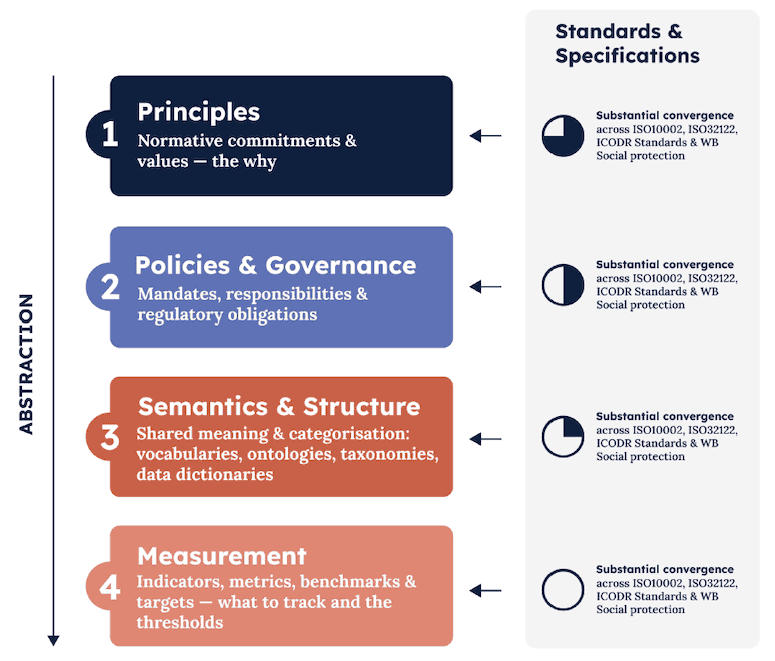
At the principles layer, our research found substantial international agreement on a number of key priorities that should underlie grievance redress. For example, the International Organization for Standardization (ISO) has published standards including ISO 10002 on complaints handling and the newer ISO 32122 on online dispute resolution in e-commerce. The World Bank’s guidance on grievance mechanisms for social protection uses different language, but all these sources converge on several core principles for redressal, including accessibility, fairness, confidentiality, transparency, responsiveness and timeliness.
At the policy and governance layer, we found greater divergence among different countries’ approaches — something that is unsurprising and probably unavoidable. In the five countries studied, legal rights to redress for public services generally exist. But the mechanics are usually left to the discretion of individual DPI entities, and there are gaps in the definitions of which services are covered by public sector redress: for example, if government payments are delivered by private-sector providers, or if there’s involvement by a government agency (like a central bank) that is not classed as providing a public service.
In the bottom half of the stack, at the semantics and structure and measurement layers, we found something more consequential. There is very little common semantic infrastructure (i.e., shared vocabularies, taxonomies and data dictionaries) for grievances, and even less standardized measurement. In other words, even though different countries increasingly agree about what good redress should mean, they lack a common way to describe what actually went wrong. That makes even basic comparison surprisingly difficult for the financiers, government oversight agencies or other entities that aim to assess these systems’ performance and coordination.
One citizen, many systems
To better understand how this lack of standardization impacts DPI users, consider someone whose identity credentials have been compromised. A fraudster uses them to open or take control of a financial account and steal the victim’s money through an instant payment rail provided via DPI. The victim discovers the loss and complains to the government, since DPI was used to establish her identity and transfer the money.
From her perspective, this theft is a single event. But institutionally, it may involve an identity authority, a private sector bank or fintech, a payment operator, a regulator, the police, and perhaps an ombudsman. Our fieldwork repeatedly exposed an underlying feature of the public’s use of DPI: Citizens experience these systems as integrated digital journeys, while the institutions that manage them retain separate mandates, databases and complaint channels. This can become problematic, as a grievance that starts in one DPI system may impact another. For instance, an error in a digital identity system can cause a denied welfare payment, while wrong information passed through a data exchange can produce a service denial elsewhere, or even an unwanted loan. Resolving only the downstream event may leave the upstream problem untouched.
This is the kind of problem interoperability is supposed to solve, without merging mandates or changing national architectures. Yet today the information needed for redress often cannot travel with the problem.
Start by agreeing on categories for recurring grievances
The first step in addressing this challenge need not be developing an elaborate technical standard like an ISO standard. It could be simply to frame a common meta-taxonomy of grievances. Payment systems, digital identity and data exchanges generate different complaints; for instance, a failed biometric authentication is not the same as a failed payment. But we found considerable alignment one level higher, among the broader types of failures DPI users commonly encounter. Across all three types of DPI, grievances can be grouped around recurring categories: access and availability failures; erroneous outcomes; downstream harm or denial of service; time-sensitive or hard-to-reverse outcomes; consent and user-control problems; misuse of data; fraud and impersonation; difficulty correcting errors; and failures in redress or appeal itself.
It’s important to strike a balance between useful standardization and over-standardization at this category level, where there may be a need for more flexibility and potential changes. Sub-codes would remain DPI system-specific. Common parent categories would make it possible to aggregate, analyze and route grievances without pretending that all DPIs are identical. Financial regulators and private-sector payment card networks like Visa and Mastercard already use structured complaint categories and reason codes, which allow complaints to be tagged and organized so they can be triaged and tracked — but these are sectoral or proprietary and cannot currently travel between ecosystems. DPI needs something more horizontal.
Moving beyond categories to create a common data object for grievances
The next, more ambitious step is to standardize not just the category of a grievance but the data object that represents it. A common grievance data object might include the category and sub-category; complainant details where necessary; whether and how the complainant was authenticated; the system or transaction concerned; time and date; a case number or code that remains consistent across DPIs; the organizations that have handled the case; the current escalation level; and status and eventual disposition.
In DPI, the purpose of interoperability is to standardize the basis which allows a flow of data between systems, not the process or the entity responsible for delivering the public service. Every DPI system or government institution need not run the same complaints platform or follow an identical legal process. The goal is not a global mega-ombudsman for DPI, which even if feasible would likely be ineffective. It is closer to what messaging standards have done elsewhere in the digital economy: letting different systems understand enough of the same structured message to act on it.
India’s Open Network for Digital Commerce offers an instructive example. Its Issue and Grievance Management framework includes a 25-field data dictionary for complaints emerging across a multi-party e-commerce network. The reason codes are specific to e-commerce, which is not widely recognized as a category of DPI, but the underlying idea — a structured grievance data object that moves between organizations — is widely applicable to DPI. Open-source systems such as DIGIT and open protocol environments such as Beckn offer other building blocks.
These are all promising signs of progress, but they’re at a relatively early stage. To advance redress for DPI as a whole, the next step DPI operators, funders and system vendors should take is to create a data dictionary defining a common data object for grievances. The most important design priority is ensuring users’ privacy, because a grievance about identity theft or a benefit denial is itself sensitive information that shouldn’t be shared. The grievance object should carry references and status information rather than evidence, record the authentication level (i.e., how robustly and with which digital ID the person identified themself) rather than their specific personal details, and show each institution involved in redressing the grievance only what it is entitled to see.
Measurement and interoperability reinforce each other
We approached this problem initially from the bottom of the stack: measurement. We developed two experimental lenses to envision how various potential solutions could be applied to different real-world DPIs/grievance redress systems. The “liveness” measure asks whether a DPI has the minimum observable characteristics of a functioning grievance mechanism. Only four of the 15 systems met every criterion, although another eight were substantially underway. A richer “wellness” framework examines how fit-for-purpose a mechanism is, but it requires far more information from operators and was beyond the scope of this phase of the project.
The exercise revealed an opportunity for DPIs to create a beneficial feedback loop (something some of these systems have already implemented). Better measurement creates pressure for common definitions: We cannot compare grievance resolution rates if “complaint,” “dispute,” “fraud case” and “chargeback” mean different things in different systems. And semantic standardization makes better measurement possible. Eventually, comparable grievance data could show governments not merely whether a complaint channel exists, but where harms originate, where cases get stuck between institutions, which groups struggle to obtain remedy, and which system changes reduce repeat grievances. Complaint data then becomes not simply evidence of failure, but telemetry for the DPI itself.
Measurement matters for another reason. Redress failures rarely originate due to technical problems: These failures more often emerge from a lack of quality management at DPI systems, born of lack of knowledge, limited vision and, frankly, no reward for doing better.
Public, comparable scorecards could change the incentives that result in poor quality DPI management. This approach remains rare, and we’ve only encountered it in an embryonic form in India, in the country’s Grievance Redressal Assessment Index. Built on Centralized Public Grievance Redress and Monitoring System data, the Index allows the government to independently rank grievance redressal across different national public services based on transparent and independently collated metrics — though it doesn’t cover all forms of DPI. Nevertheless, it represents a promising step toward greater transparency and accountability in public services, since politicians, civil society and the general public can also monitor it. These types of shared conventions will not create quality government services, but they do make these services visible and comparable when they exist.
Making grievances legible to one another
The need for interoperability is growing as DPI crosses borders. National instant-payment systems are interconnecting, users’ credentials are being designed for recognition abroad, and data exchange will follow. Yet cross-border interoperability is being engineered faster than cross-border redress. Formal international standards may eventually be needed here, but they are not the right place to start. Instead, DPI grievance redress systems should move toward standardizing their operating conventions across countries, beginning with DPI operators and the vendors of the case-management systems they use within individual countries — something that doesn’t require formal, whole-of-government approval.
The first generation of DPI interoperability focused on building society-scale digital systems that can transact — whether that transaction involves data or payments. The next must ask: When a transaction goes wrong, can information about the problem travel across DPI systems until the issue is resolved? The global movement toward DPI does not need a single redress institution or identical national rules. But it does need a shared vocabulary, a common grievance object, persistent case identifiers and interoperable handoffs among national entities and across borders where needed.
If DPI is interoperable when it works, redress must become interoperable when it doesn’t.
David Porteous is the founder of Integral: Governance Solutions; Maria Luciano is a policy analyst specializing in technology policy, inclusive data governance and digital government; Deepti George is founder of Yutadhi; Sahana Arun Kumar is co-founder of Amarante Consulting.
Photo credit: PeopleImages
You May Also Be Interested In:



- Categories
- Technology