The Three Ingredients of Impact AI: Research from India Offers Guidance for AI for Social Good in Emerging Markets
The conversation around “AI for social good” has moved beyond hype and potential, and into a high-stakes implementation phase, as a growing number of real-world use cases have emerged. The critical question is no longer whether impact-focused AI could work, but whether it is working.
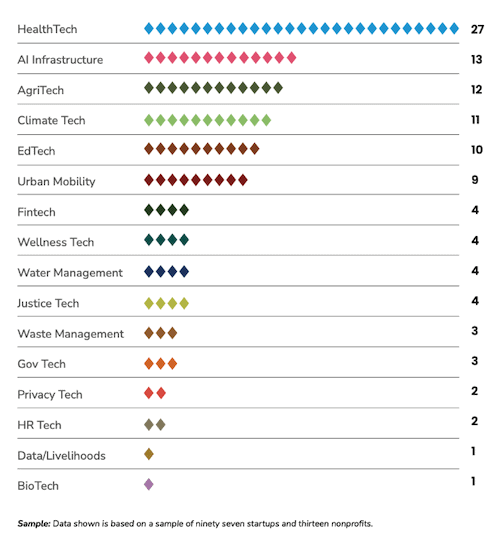
Source: India’s AI Impact Startups, Kalpa Impact
In the run-up to the India AI Impact Summit hosted this February in Delhi, Kalpa Impact conducted an analysis of 97 startups and 13 non-profits deploying AI for social good at population-scale. We sought to understand who is building these tools, where they are being deployed, and most importantly, if there is evidence of impact.
Our analysis culminated in the launch of a report on India’s AI Impact Startups, published jointly by Kalpa Impact and India AI.
A few key insights emerged. For instance, of the surveyed startups and non-profits, a majority were building in HealthTech, AI Infrastructure, Climate Tech, EdTech and AgriTech. A further breakdown can be found in the chart on the right.
We also found that global tech giants like Facebook, Amazon and Google do not dominate the impact AI space in India. Instead, the ecosystem remains decentralized, with startups focusing on real-world opportunities to improve citizen lives.
We’ll share other learnings from our analysis in the article below, highlighting three key ingredients that can enable the successful deployment of impact AI in India and other emerging markets.
The First Ingredient: Localization
The first ingredient of impact AI — localization — refers to solutions which consider the entire ecosystem, are collaborative, and have a clear focus on addressing root issues.
India’s population is estimated to have exceeded 1.4 billion across 28 states and eight union territories, each with its own languages, customs and development challenges. From our analysis, we found that successful technology deployments build for these realities — for instance, by meeting the varied needs across both developed urban communities and rural and remote areas with poor internet infrastructure and zero to no internet connectivity. A one-size-fits-all approach falls flat in India’s diverse landscape.
Let’s take a look at AgriTech. India’s farms represent a strong opportunity to leverage AI for decision-making by integrating weather data, soil insights and market signals to empower farmers with guidance and unlock more efficient, resilient agricultural systems. Solutions like DeHaat, which provides AI-enabled insights and market access platforms for smallholder farmers, are revolutionizing the sector. For example, DeHaat delivers personalized recommendations on hyperlocal weather forecasting, soil analytics, produce quality grading and linkages to institutional buyers through its multilingual DeHaat Farmer app, combining digital intelligence with last-mile presence. The free app supports a reported 1.8 million farmers across 12 states, and its impact has been recognized by NASSCOM, Forbes and Niti Aayog.
The Second Ingredient: Building for Edge and Offline Use
The second ingredient of successful population-scale impact AI interventions involves building for edge use and completely offline usage. In our sample, only 8% of startups prioritized edge AI, which processes data locally on the device rather than sending it to the cloud. This approach to offline AI is crucial for product adoption in Indian villages with poor to no internet connectivity, and in remote areas that often lack relevant internet infrastructure altogether. Edge AI has the added benefit of being significantly cheaper, and reinforces user control over privacy and security features.
Netradyne, a fleet management system which operates across commercial vehicles from semi-trucks to heavy diesel fleets, applies this principle by moving processing from the cloud into the vehicle. Its fleet safety system uses on-device AI to monitor driving time and identify risk signals like fatigue or lane deviation, triggering real-time audio alerts for driver self-correction.
Similarly, Pinky Promise, a HealthTech AI app, provides advice on women’s sexual and reproductive health for rural communities with low internet access. Built by a team of gynaecologists and other doctors, Pinky Promise has been recognized for its ability to provide specialized medical advice to women in areas where meeting a gynaecologist often means travelling to big cities, spending out of pocket and combatting the stigma associated with seeking out these services. Since its launch in 2022, Pinky Promise has reached 200,000 women with its services.
The Third Ingredient: Voice-first Access
In India, AI for social impact features a vital third element: voice-first AI access. For those who sit at the intersection of literacy and digital divides, voice-first AI design allows users to interact in a way that feels accessible, convenient and low-touch. For many developers in India, voice-first AI is at the point where it’s considered an infrastructure layer — i.e., a core product component across multiple use cases. In our report, 28% of early-stage startups utilized voice-first AI approaches.
Several organizations and government initiatives in India (e.g. Sarvam and Bhashini) are building voice AI models for their specific use cases and publishing them as open source for others to use. By doing so, these multilingual AI models become shared infrastructure, allowing interoperability and mitigating vendor lock-in.
One emerging use case for voice-first AI involves India’s justice system, which is constrained by long wait times, legal complexity, a dearth of linguistic information, and knowledge asymmetry. In response, JusticeTech applications like Jugalbandi’s free voice-first multilingual AI assistant help citizens understand and access government schemes, public services and official information. Jugalbandi works across 170+ government schemes and has been recognized by Microsoft CEO Satya Nadella and studied by Harvard Business Education.
The Keys to Scaling Impact AI Across Emerging Markets
The Indian AI-for-impact ecosystem is growing rapidly, and while the longevity and efficacy of each of these startups and non-profits remain to be seen, one thing is clear: There are proven approaches to promoting greater AI use and maximizing AI’s ability to make lives better across geographies.
We have found these three ingredients — localization, edge and offline AI, and voice-first AI — to be key for scaling impact AI in India. But these findings are not only relevant to the Indian market. Prioritizing these elements can help startups across emerging economies transcend regional, language and economic barriers to ultimately overcome systemic exclusion.
India’s approach offers a useful playbook that can be applied in other countries where access and infrastructure remain uneven. In these countries, the future of AI will be shaped as much by how systems are built and deployed as by the technology itself.
Sushant Kumar is the Founder and CEO of Kalpa Impact; Ananya Mukherjee is a senior consultant with Kalpa Impact.
Photo credit: SR Mahakhud
You May Also Be Interested In:


- Categories
- Technology