What Drives Positive Outcomes in Gender-Lens Investing? DFI Portfolio Evaluations Reveal Four Key Factors
Few developments have been as striking in the impact investing space as the rise of gender-lens investing (GLI) since the 2018 launch of the 2X Challenge. Since this initial commitment from G7 countries’ development finance institutions (DFIs) to mobilise capital for gender equality, the associated 2X Criteria has now become the global industry standard for assessing and monitoring GLI. The 2X Criteria provide a clear framework for identifying and structuring investments that advance gender equality, including through women’s entrepreneurship, access to leadership positions and quality jobs, and the provision of products and services that benefit women and girls.
Now, for the first time, a synthesis of portfolio evaluations involving British International Investment, Proparco, FinDev Canada and FMO, undertaken by Kore Global, provides portfolio-level evidence on the outcomes and impact of these DFIs’ gender-lens investments at scale. The synthesis provides a strong validation of the 2X Criteria framework as a screening tool for gender-lens investing. The evaluations consistently show that meeting the 2X Criteria is a strong predictor of positive outcomes for women as employees, leaders, entrepreneurs and consumers. Moreover, entities that meet the Criteria’s threshold for the representation of women in leadership have especially strong gender outcomes.
Although these findings may not be surprising, this new body of evidence also provides insights into a less discussed area: how and why some investments achieve deeper and more meaningful gender outcomes than others. For example, it highlights:
- The specific client-level factors and mechanisms that enable or hinder progress on gender outcomes;
- The extent to which leadership commitment, internal accountability and organisational culture shape gender outcomes; and
- The importance of a client’s internal gender expertise in enabling meaningful change.
As gender-lens investing continues to mature — and as a growing number of investors seek to go above and beyond the 2X Criteria — understanding these drivers of success is critical. By identifying not only what works but why, and under what conditions, investors can deploy capital more strategically and support deeper, more sustainable impact.
Using Behavioural Science to Predict Gender Performance
To truly drive gender-smart business practices, it isn’t enough to just set targets; we need to understand the behavioural science behind why investees (companies, funds, financial institutions, etc.) adopt or fail to adopt gender-smart practices and behaviours. Kore Global’s analysis showed that the investments with the strongest gender outcomes were not concentrated in one region or sector. Instead, we found that the top performers across the 81 investments we evaluated shared a set of common enabling factors, which included internal Capabilities, external Opportunities and a clear Motivation to prioritise gender equality: the three components of the COM-B model for behavioural change.
Using this framework to understand what drives investees’ gender-responsive business practices, our evaluation identified four factors that drive gender equality outcomes (see Figure 1 below).
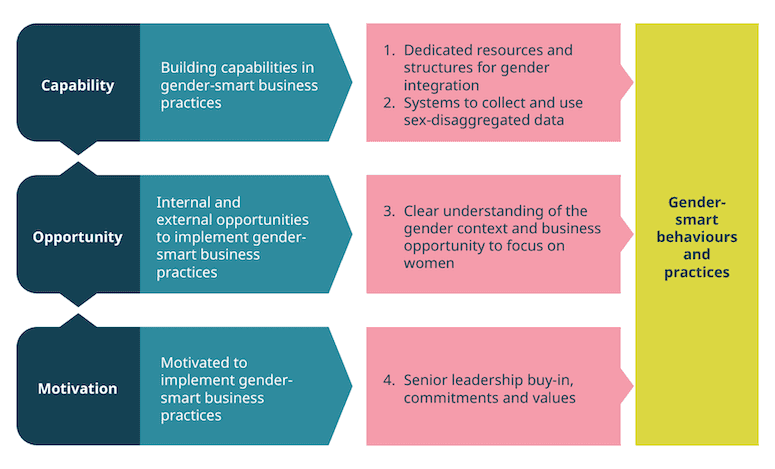
Figure 1: Enabling factors driving gender-smart behaviours and practices
Looking at three case studies from FinDev Canada’s portfolio evaluation, we can see how these factors lead to transformative changes in gender-smart business behaviours and practices.
- Dedicated resources and structures for gender integration: These enable investees to build gender expertise, embed gender considerations into decision-making, and achieve stronger gender outcomes. For example, LAFISE Investment Management, manager of the Central American Small Enterprise Investment Fund IV (CASEIF IV), appointed a dedicated Sustainability and Gender Officer and developed tailored gender action plans for portfolio companies. Similarly, Climate Fund Managers (CFM), through its Climate Investor One fund, adopted a group-wide gender policy and fund-level action plan, providing a clear framework for integrating gender considerations into its operations and investment.
- Systems to collect and use sex-disaggregated data: Robust data systems enable investees to understand where women are or are not being reached, identify gaps, and adapt their strategies accordingly. Ecobank, for example, upgraded its monitoring systems to better track women entrepreneurs in sub-Saharan Africa across its customer base and portfolio. These gender-disaggregated insights helped strengthen the business case for serving women-owned businesses and informed the design of products and services under its specialised banking programme Ellevate, which has reached over 73,000 women entrepreneurs to date.
- Clear understanding of the gender context and business opportunity to focus on women: This understanding enables investees to move beyond compliance and recognise and act on the commercial and development opportunities associated with a gender-responsive approach. For instance, Ecobank’s Ellevate programme was built on the recognition that women entrepreneurs represent an underserved and commercially attractive market segment, which could be reached by combining financial products with leadership development, training and market access. Similarly, CFM leveraged practical frameworks such as the Women’s Empowerment Principles to deepen its understanding of gender dynamics in the climate infrastructure sector and identify opportunities to strengthen both inclusion and climate resilience.
- Senior leadership buy-in, commitments and values: Leadership commitment plays a critical role in sustaining momentum and signalling that gender equality is a strategic priority. In the case of CASEIF IV, senior leadership commitment was instrumental in embedding gender considerations throughout the investment process. At Ecobank, senior gender champions and dedicated governance structures have ensured that women’s economic empowerment remains a strategic priority across the bank’s operations. Meanwhile, CFM’s leadership commitment, reinforced through engagement with FinDev Canada and the adoption of the Women’s Empowerment Principles, has embedded gender equality within the fund manager’s broader ESG and climate strategy.
By focusing on these four factors, investors can provide targeted support to their investees to move from abstract intentions to concrete behaviors, ultimately strengthening both gender outcomes and business performance.
Why Does this Matter?
This synthesis highlights how meaningful advances in gender equality aren’t just an accident of where a company is located or what sector it operates in; they are driven by the intentional choices that businesses make to embed gender-smart practices into their daily operations. By prioritising these deliberate strategies — grounded in their gender-related capabilities, opportunities and motivations — businesses can create lasting gender outcomes that go beyond basic compliance.
DFIs and values-aligned investors alike can build on these four enabling factors to strengthen the integration of gender considerations across the investment process, thereby deepening impact across their portfolios. For example, these factors can be integrated into sourcing and due diligence processes to prioritise deals with the greatest potential for positive gender impact. They can also be incorporated into deal structuring as targets for investees, or in the delivery of tailored technical assistance support.
Encouragingly, we have seen that DFIs are already beginning to adjust their gender-lens investing approaches by turning evaluation findings into a blueprint for better results. These institutions are now refining their strategies to reflect COM-B factors: from tightening up screening and due diligence, to investing more heavily in client support and advisory services. By leveraging evaluation insights, DFIs are now better able to identify high-impact opportunities that will drive real change for women globally.
By sharing these insights, we hope to support investors’ efforts to move beyond screening with GLI frameworks such as the 2X Criteria, to actively shaping the conditions that enable deeper and more transformative gender outcomes.
More details about these examples can be found in FinDev Canada’s published case studies.
Katie Turner is an independent consultant with over 15 years of experience in gender-lens investing; Jenny Holden is a Principal Consultant at Kore Global.
Photo credit: Jacob Wackerhausen
You May Also Be Interested In:



- Categories
- Investing