Mini-grids May Not Be the Answer: Why Shifts in Technology and Funding Have Changed the Energy Access Outlook in Africa
There is intense pressure to reach universal electrification by 2030, which requires a further 666 million people to be electrified — most of whom live in sub-Saharan Africa. However, at the current rate of progress, the world will not achieve that goal.
The solution is often framed as hinging upon mini-grids, which many view as a key pathway toward universal energy access. With some estimating that mini-grids will need to account for 40% of all installed capacity, there is growing pressure on the private sector to step up and make the necessary investments in this technology. Mini-grids are also an attractive energy access option for policymakers, as they can ultimately be connected to the state utility to provide a national grid, which is seen as the gold standard for electrification.
But this focus on mini-grids may be distracting policymakers in both the public and development sectors from faster, more cost-effective solutions, resulting in misallocated resources and slower progress.
Below, I’ll explore why mini-grids — despite being a good solution in some areas — have a number of under-reported constraints, and why emerging alternative solutions may present a more realistic path toward universal energy access. For the purposes of this article, I am focusing on AC (alternating current) mini-grids that are compatible with the national utility, and that usually include a central generating site connected to households by distribution lines.
Understanding the Downsides to Mini-Grids
Mini-grids have a number of downsides that are often overlooked in the discussion around energy access:
They are slow to develop: Mini-grid projects typically require a 20-year concession agreement, due to the longevity of their generation and distribution infrastructure, and the time they usually need to generate a return that will attract investors. These agreements prohibit others from selling electricity by the kilowatt-hour (kWh) and building a distribution network, creating a localized monopoly for these projects. However, governments are understandably cautious about agreeing to 20-year, legally binding concession contracts, for fear that they will be exploited by private sector companies or their investors, some of whom have been seen to leverage these agreements to generate overly generous returns. This leads to multi-year negotiations, which causes delays and results in large project set-up costs.
They are expensive for most rural and peri-urban areas: The 666 million that still remain unelectrified will mostly end up using their newfound energy access for lighting, phone charging, a fan and perhaps a TV. Only a few will be able to afford fridges, washing machines or air conditioning. In Africa, average consumption for residential customers on existing mini-grids is between 6 and 8 kWh/month, and for commercial users it is between 13 and 40 kWh/month. Based on my calculations, using data from the African Mini Grid Developers Association, the average cost per mini-grid connection is $1,734, and the average OPEX (i.e., operation costs such as salaries, repairs and maintenance) per connection, per month is $1.75. Hence, a mini-grid project seeking to generate a pre-tax return of 10% (the lowest return most investors will accept, given the risk) needs to generate $173.40/year, or around $14.50/month. Adding on OPEX of $1.75 gives a required revenue of $16.20/month. So even if electricity usage averages 10 kWh/month, an optimistic estimate which assumes significant commercial usage, the project would need to sell its electricity at a minimum price of $1.62 per kWh. This is far higher than what most African mini-grid customers pay, and what most regulators would allow.
At Bamboo Capital Partners Access to Energy (BCP), our recent experience has shown that mini-grid connection costs are falling to close to $1,000 per connection. But that still requires the mini-grid to charge customers $1/kWh to generate a 10% return for investors, and for larger electricity customers this pricing is not competitive with a diesel generator set, or installing their own solar generator. Yes, subsidies can bring down the price per kWh, but the scale of subsidies needed to electrify 666 million people with mini-grids is unaffordable, and private sector capital will always be wary about whether high subsidy rates will continue for the long term.
The penetration rates are too low: With low consumption and dispersed households in rural areas, the cost of the distribution lines becomes a large part of the system cost, making it uneconomic to serve these households. Based on the mini-grids that BCP has seen, as the manager of World Bank-funded energy access programs in Haiti and Madagascar, the penetration rates on mini-grids are often no more than 20% of the households in the concession area. This is not enough revenue to keep up with the rising costs of providing mini-grid electricity: While power generation assets like solar PV, batteries, inverters and controllers are seeing continued cost declines, with battery storage costs in particular falling by 36% between 2022 and 2025, the materials used in distribution lines are seeing real cost increases, especially as copper prices continue to rise. For rural mini-grids, this results in an overall cost increase for isolated customers.
The good news: there are now alternatives to mini-grids
Despite these challenges facing mini-grids, the broader outlook for energy access in Africa is improving, as a number of alternative electrification approaches have become more widespread and more affordable. These alternatives were not available five years ago, when many of today’s mini-grid projects were being conceived. In 2020, battery storage costs were almost 57% more expensive than in 2025, making the goal of serving 100% of customer need with solar uneconomic. As a result, diesel generator sets were needed to cover peak loads, and due to the economies of scale of these generator sets, a centralized site was needed to make their usage economic. But now, with the decline in battery costs, covering 100% of electricity needs with solar generation is possible in many countries, allowing less centralized, more distributed generation.
These alternative solar electrification options now include:
Solar Home Systems (SHS): These had long been dismissed by policymakers as not “real” electrification, as they only enabled lighting and did not give a path to increased use for commercial activities. However, a modern 12W SHS can deliver all the lighting and phone charging that a household needs for less than $80. Larger 50W systems can supply 3 to 4 kWh/month, enough to cover the needs of most rural families. While they’re traditionally sold as consumer products, several private sector projects in Africa are providing access to these devices through a utility-run “Energy as a Service” (EaaS) approach, where the assets are owned by the utility and customers pay a regular fee to use them. This allows the utility to incorporate these products into its offerings and extend its services to more remote customers — an approach BCP is currently funding and testing in Mozambique and Madagascar. This EaaS model can even enable utilities to reach the many households in Africa that have a combination of low consumption (less than 1 kWh/month), and high distance (more than 30 meters) between other households.
Solar generators: Cost reductions in the key components of solar generators have reduced their prices, so standard off-the-shelf solar generators are available in inverter sizes between 300W and 10 kW, costing between $300 and $6,000, and able to deliver between 15 and 250 kWh/month, allowing almost all businesses to be supplied by solar generators. The recent GOGLA report on Solar Generators in Nigeria showed median consumption for households and MSMEs at 7.4 kWh/month and 7.5 kWh/month respectively. According to my estimates, as long as these solar generators are sized correctly, they will deliver electricity to customers at between 35 and 16 cents/kWh without any subsidy. This is usually lower than the cost customers would pay to a mini-grid, even after subsidies.
Mesh grids and nano grids: Though these technologies are variations on the mini-grid approach, they keep their generation facilities as close as possible to electricity users, reducing the need for, and cost of, power lines and other distribution assets. Both of these approaches essentially consist of a solar generator whose power is shared between a small number of interconnected households located nearby.
Mesh grids typically use DC (direct current) power to connect users to the point of electricity generation/storage, and also to interconnect distributed batteries and share battery capacity. Inverters are installed at the point of usage to provide AC power. Although LED lighting and IT equipment uses DC power, most equipment is sold to accept AC, as this is the prevailing means of electricity distribution — hence, AC is essential for any productive use. DC distribution has the advantage of being safer to install and much harder to steal from interconnecting cables. But it requires a maximum working distance of 25 meters between the generator and the household, so mesh grids can typically only connect five or six households per generator/battery. The cost per connection is typically $450 for rural areas, and where there are clusters of houses, which is often the case, the penetration rate can exceed 50%.
Nano grids distribute AC power at the standard voltage (230V or 110V) over a small area. Their advantage is that the maximum distance between the generator and the connection can reach 100 meters, and there is no requirement for an inverter at each location. So they can service more households from one battery than DC mesh grids, which has cost advantages in areas of low demand. However, their higher voltage makes safety an issue, and theft of AC power is easier than DC. Their cost per connection is also around $450.
The advantage of the above approaches is that they:
- Reduce the need for a formal concession agreement: As generation assets are easier to move than distribution assets, less exclusivity is required to attract private sector investment. The regulator can also allow more competition to control pricing, while still enabling the private sector to earn a return that will attract investment — and no land needs to be acquired. These factors allow for much faster installation, with many fewer administrative procedures.
- Require less grants: In an era of steep reductions in aid, grants have become more difficult to get. The focus needs to be on getting the most electrification for each grant dollar. Using a combination of the above technologies, BCP’s estimates show that funders should be able to finance the provision of adequate electricity with grants of less than $300/connection, which is about half the current rate for mini-grid grants in Africa.
- Lead to higher penetration rates: The population density of rural sub-Saharan Africa is about 30 people per square kilometer, according to my estimates. At 6.9 people per household, this means the average spacing between households is around 480 meters, if homes are uniformly spaced. While the average hides a variety of different household densities in different locations, it shows how important it is to reduce distribution costs in a rural setting. Mesh grids and nano grids work best where there are clusters of houses which can be served with one battery/PV array. This is often the case in rural Africa. From my experience there are often clusters of 10 to 30 households, separated by several hundred meters from other clusters.
The World Bank, GEAPP and various country governments are working to test these concepts. Mesh grids are part of the Distributed Access to Renewable Energy Scale-up (DARES) program in Nigeria, which includes five mesh grid developers. Mesh grids are being developed in Haiti, supported by the Global Energy Alliance under a program managed by BCP. Solar home systems, used to supply EaaS, are being tested in Senegal, Sierra Leone and Malawi and piloted by BCP in Madagascar and Mozambique, where a call for proposals covering innovative grids has attracted additional solutions involving Energy-as-a-Service and mesh and nano grids. Meanwhile, solar generators are building sales rapidly throughout Africa, demonstrating that they can usually supply electricity to small businesses at a lower cost than mini-grids.
Maximizing the Impact of Grant Support
Drawing from BCP’s experience across a range of electrification programs, the table below represents indicative benchmarks for electricity consumption, the cost to profitably provide a new connection, and the grant support needed to attractive private sector investment as debt or equity across different technologies. While every project is unique and actual figures may vary by region and by context, these estimates help illustrate the relative economics and scalability of the various approaches discussed above.
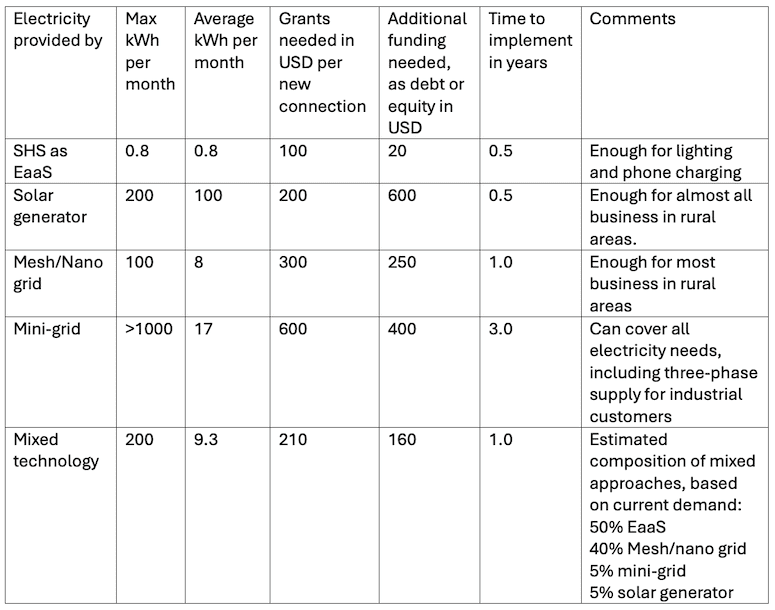
Chart: Types of electrification approaches and funding needed
The 666 million people who still lack energy access represent about 130 million households. Based on the estimates above, I calculate that if these households were electrified exclusively with mini-grids, it would require $78 billion in grants and $52 billion in additional investment. For a mixed technology solution, the funding needs would amount to $27 billion in grants and $21 billion in additional investment.
In 2023, total aid to Africa was around $65 billion — a number that aid cuts have reduced substantially in the subsequent years. This makes mini-grids too expensive to consider as the primary solution for bringing electricity to excluded households across the continent.
To reach universal electrification by 2030, we need to move faster and recognize that aid money is limited. I suggest that this requires a different approach:
- Incorporating SHS as EaaS, solar generators, mesh grids and nano grids into the mix of tools available.
- Providing the electricity needed now, instead of building systems that won’t have all their capacity used for several years into the future. With declining real costs for solar power generation, it makes sense to postpone expenditure where possible.
- Leveraging the private sector to evaluate the most cost-effective way to provide the electrification needed in the short term to allow economies to expand. Policymakers should be technology-neutral, and should give the private sector freedom to determine the best way to achieve universal electrification via whichever emerging technologies meet customer demand with the lowest amount of grant support.
The energy access landscape in Africa has changed, and a grid-based approach built around centralized generation and remote distribution may no longer make sense in many markets. New funding limitations necessitate a new strategy, one that new technologies are ready to enable: It’s time for the sector to examine these alternative approaches.
Stewart Hicks is a senior advisor to Bamboo Capital Partners Energy Access which is implementing World Bank-funded off-grid electrification programs in Haiti, Madagascar, Mozambique, Burundi and Niger.
Photo credit: MDV Edwards
You May Also Be Interested In:

![The Clock is Ticking on Energy Access: Exploring Factor[e] Ventures’ Big Bet on Mini-Grids](https://nextbillion.net/wp-content/uploads/Fig.1.FactorE-150x150.png "The Clock is Ticking on Energy Access: Exploring Factor[e] Ventures’ Big Bet on Mini-Grids")

- Categories
- Energy, Environment, Investing, Technology