Moving Beyond Grants: How NGOs Can Diversify Toward Earned Revenue, and How Funders Can Support That Transition
The global development sector is not short on promising social innovations. In health, education and climate, among other sectors, NGOs have built innovative solutions to societal problems that have reached their desired impact: They work in the places they were designed for, often at a cost-per-user that no commercial operator could match. Getting them to scale is the harder problem, and it is getting harder as official development assistance falls at a historic rate.
However, scaling these innovations could also provide NGOs with a solution to that funding challenge. The development sector has reached a firm consensus that it needs to depend less on grants, so hybrid business and operational models are becoming increasingly important for NGOs seeking to remain sustainable, relevant and adaptable as the aid landscape evolves. There’s a growing need for these organisations to explore approaches like rethinking their funding architecture, claiming a clearer niche, and evolving the support systems they can draw on. Strategies to generate earned revenue could play an important role in that ongoing evolution toward diversified funding.
But this transition often costs money before it makes money. And this “messy middle” — the period where early support falls away before a business model can stand on its own — is where social innovations stall. This is the stage the Enabel Innovation Hub focuses on. Enabel is the Belgian Agency for International Cooperation, and its Innovation Hub supports mission-driven organisations in Africa and the Middle East in scaling innovative solutions to complex societal issues. The Hub’s research looked at what has to change from within for NGOs to execute this transition — an organisational and mindset shift the sector has been far quicker to call for than to fund. And what we learned is that the transition between grant dependency and financial sustainability goes beyond finding a different type of payer. Instead, it may require an organisation to change what it provides and to whom, how it is governed, who it employs, and what it chooses to say “no” to.
There is no clean path from grants to revenue
Since 2018, the Enabel Innovation Hub has provided “transition-to-scale” support to over 50 non-profit social innovations across 18 African countries through grant funding and capacity-building technical assistance.
For a long time we worked on the assumption that scale — funded by a larger grant with more ambitious targets — was the next natural step after a successful pilot. But our grantees’ lived experience showed us that doing more of the same thing in more places is rarely what the job requires. The harder task is changing what an organisation is and where its money comes from.
Those changes were easier to contemplate when grant budgets were growing. Now they are shrinking while expectations rise, and NGOs are being told to diversify as though there were a clear route from grant money to a sustainable model, in markets where programme beneficiaries cannot afford the full cost of the service or product being provided.
To better understand how NGOs are successfully diversifying, we undertook a study involving 18 mission-driven organisations operating across Africa, with varying degrees of financial diversification and at different stages of their journey. Our goal was to better understand how NGOs can scale their innovations while pursuing financial sustainability.
We found that as organisations scaled, financial sustainability was often a condition they continuously managed, with diversification often being the first visible shift. Of all the organisations we spoke to, almost none had moved neatly from grants to earned revenue. They layered and rebalanced income streams as circumstances changed, whether due to funding volatility, policy shifts, affordability pressures or operational demands. Shocks such as losing a grant often prompted diversification and model evolution more than strategy alone.
Financial diversification is not the same as scaling, but it brings many of the tensions involved in scaling to the surface. Deciding to sell something forces an organisation to figure out what it is uniquely good at, who will pay for it, and whether it is prepared to stop some of its regular programming to make space for this new focus (or to hand over its innovations to external partners that will take them to market).
Diversification did not relieve short-term financial pressure for the NGOs we spoke with, because it introduced complexity and demanded capabilities the organisation did not yet have. However, we did find that those NGOs that were more financially diverse were often the most resilient.
The Anchoring-Balancing-Compounding Archetypes
To make sense of the patterns we were seeing, we developed the Anchoring–Balancing–Compounding (ABC) archetype model. It describes three archetypes that non-profits occupy and move between as they diversify their funding sources. And crucially, it identifies the different demands each one places on the organisation and its backers — e.g., showing funders the different types of support required.
Anchoring organisations are predominantly grant-led, bringing in a small share of earned income that helps subsidise costs while grants remain their main source of revenue. Their most pressing need is room to experiment: unrestricted or flexible capital to test revenue models, support to work out pricing for users who cannot pay the full cost, and permission to fail without a restricted grant’s deliverables pulling them back toward premature scaling.
Balancing organisations run grants and earned revenue in rough parity and are actively holding mission and commercial logic together, often through dual legal structures. Here the constraints shift from experimentation to management, creating a need for other types of support — e.g.: governance and legal support for a hybrid structure, working capital to run several income streams at once, and assistance with the harder, less fundable task of managing the tension between mission and revenue as both grow.
Compounding organisations are led by earned income, retaining grants for what markets cannot or should not fund, and they often present as social enterprises with a strong core mission. Their needs are different from those of the other two archetypes, and they include: strategic, catalytic grants ring-fenced for any non-commercial work, the partnership and government-relations capacity to embed into public programmes or procurement systems at scale, and the evidence infrastructure that performance-linked or outcome-based finance demands.
These archetypes raise two key questions for non-profit organisations: Which financial model best serves the organisation’s mission, and what would it need to change to operate with that model?
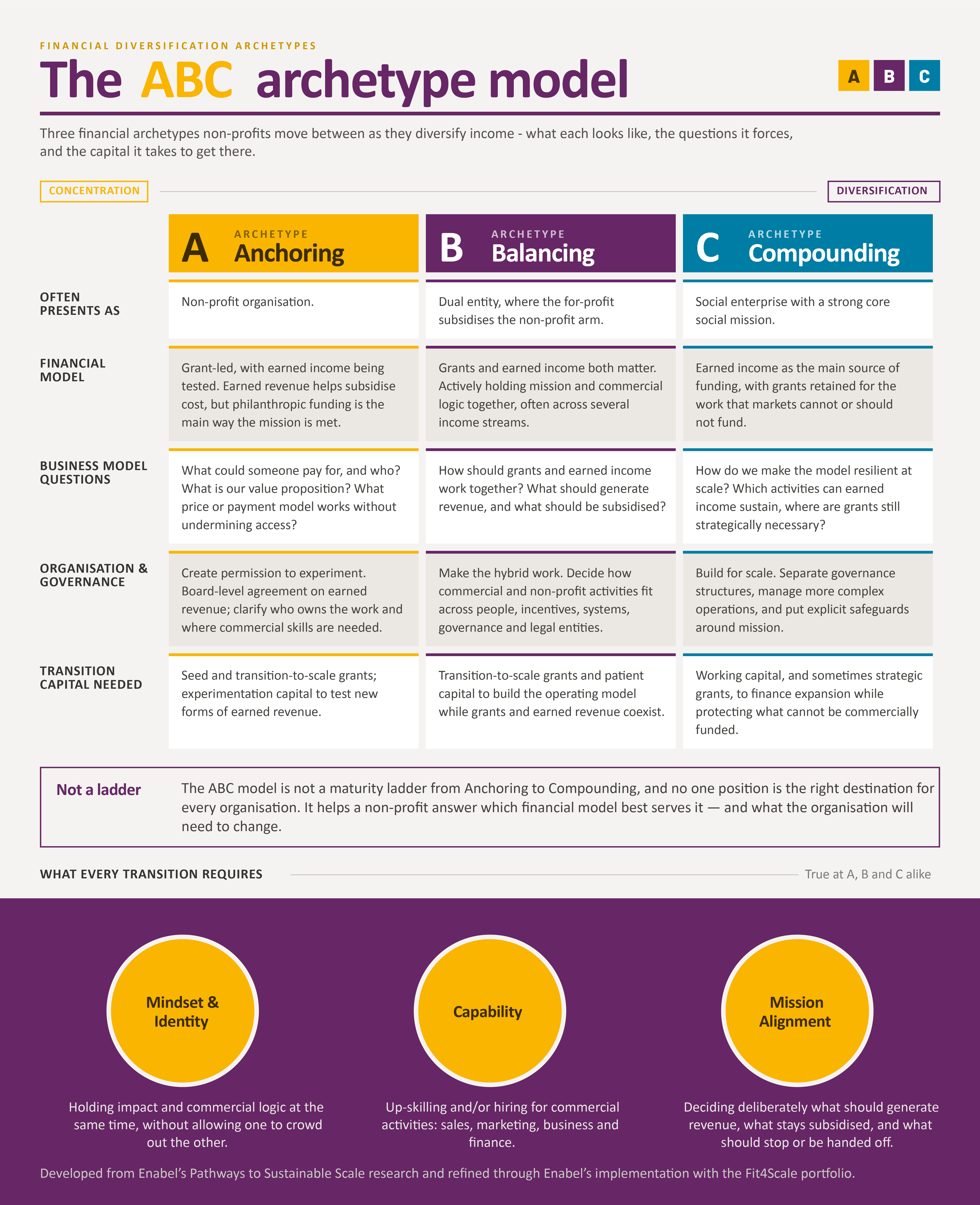
The ABC Archetype Model, developed from Enabel’s Pathway to Sustainable Scale research and refined through Enabel’s implementation with the Fit4Scale portfolio.
The capacity limbo that no one pays for
An organisation moving into Anchoring, Balancing or Compounding brings assets a new commercial entrant would need years to build. Most have spent a long time working in contexts where markets are thin and public budgets are constrained. They’ve also built relationships a newcomer simply doesn’t have. They know how to design with users rather than for them, and how to translate between what is happening on the ground and what a donor’s reporting template will accept.
However, none of that transfers automatically to a commercial model. Knowing a community well will not tell you how to run three income streams at once, price a service that has never had a price before, or judge when another organisation is better placed to carry an innovation forward. Those are different jobs, and they usually need different people.
This challenge can be seen in the insights we learned from Aflatoun, a global education organisation that empowers children and young people through social and financial education. It set up AflaVentures as a profit-making arm to generate earned income, and then could not staff it with the parent organisation’s existing team. According to a representative at the organisation: “AflaVentures has mixed success, partly because as an NGO … you really need to have commercial people to be successful in that, and finding a person who is interested in doing commercial activities for a nonprofit isn’t easy … at the moment we are not doing fantastic in that area but it’s purely a staffing issue more than anything else.”
Hiring is one part of the transition. A commercial function also has to sit inside an organisation whose systems, incentives and culture were built for non-profit delivery, and that can require a second legal entity with its own board.
In situations where the current team cannot stretch far enough, the grant work and the commercial work compete for the same people. For instance, Green Farmlands has a core team small enough that staff double up across roles. Yet it cannot resource everything at once, so it chooses between its non-profit activities and its revenue-generating ones month by month.
The organisations we interviewed described this as capacity limbo: more demand and opportunity than the team and its systems can carry. This situation is most challenging when an organisation is moving from founder-led delivery to formal operations, or running an innovation alongside core programmes with no dedicated capacity for either. At myAgro, for instance, roles shifted every few months and process knowledge sat informally in people’s heads, which made it difficult to bring in new staff.
This is why the form of support offered to these organisations matters as much as the amount. NGOs at this point need funding that’s flexible enough to let them build capability and change course when a model fails. They also need backers who behave as learning partners rather than compliance monitors checking whether fixed project deliverables have been achieved.
The hidden challenges behind financial diversification
To help address these interrelated challenges, Enabel launched its Fit4Scale initiative earlier this year, which aims to build the capabilities NGOs actually need as they pursue financial diversification and scale, working directly with the leaders who have the decision-making power to make these calls.
We’re supporting organisations’ efforts to: test new commercial business lines which bring in earned revenue, establish commercial enterprises, set up governance mechanisms that can subsidise their non-profit activities, and explore partnerships and alternative funding models to scale their innovations.
But these structural model shifts are only part of the decision. Underneath lie harder challenges.
One involves a change of mindset. Much of the NGO world is built around a particular idea of social mission: doing good for its own sake, delivering projects, meeting donor commitments, etc. But earning revenue requires a different mindset that enables the marketing and selling of products and services — one that holds a commercial logic alongside the social one. This not only changes what an organisation does, it also changes the kinds of people it needs to do it. As Mark Thomson, Director of Business Strategy and Delivery at IWMI, a global research organisation addressing water challenges in developing countries put it: “The hardest shift for IWMI hasn’t been strategic … it is cultural. We had to stop thinking of our digital tools as project outputs and start thinking of them as products that need to be maintained, improved and sustained over time to deliver ongoing impact. That reframe sounds simple, but it cuts against decades of how research institutes are funded and how our people are incentivised. Grant cycles reward novelty. Sustaining what works well requires a completely different mindset.”
The other challenge is often more emotional: balancing mission alignment. Financial diversification forces NGOs to confront questions around mission drift — e.g., as you bring in earned revenue and new capabilities to scale your innovation, does this protect your mission or shift you further away from your original purpose? As Ian Pringle, Executive Director of Farm Radio International described it: “Our expertise in participatory communication, audience engagement, radio, digital platforms and data, for example, can be viewed not only as tools for delivering development programmes, but as capabilities that can solve problems for other organisations. The difficult part is knowing what to commercialise without commercialising our purpose. For Farm Radio, the test is not simply whether something can generate revenue. It is whether we can build a viable offering around what we do exceptionally well, while continuing to reach the people and communities who are unlikely to be served by a purely commercial model.”
Scaling can also mean partnering with others to bring in the skillsets the NGO doesn’t have, sometimes handing them a piece of what the NGO built. And that’s often where the discomfort sits. Handing an innovation to someone else to scale can feel like losing it, even when another organisation is better placed to carry it forward. As Martin Jacobs, Global Rehabilitation Specialist at Handicap International put it: “For the first time, we are looking at our eHealth application through a scaling lens. Instead of simply asking how to do more with more inputs, such as replicating a pilot elsewhere, we are examining our unit cost of delivery and our long-term financial model. This puts our mission as an NGO into question: Where does our mandate end? When and how should we let go and hand the solution to others better equipped to commercialise it? And how do we ensure those partners prioritise impact over profit?”
Commercialisation can pull financial resilience and organisational values into direct conflict. Earned revenue can be less reliable than a long-term grant, particularly in thin markets with volatile demand. And diversification only leads to scale when there is a market to diversify into, which can rule out a substantial share of the work the development sector exists to do. Additionally, though deciding to spin off a commercial activity is perfectly valid (and often represents the most sustainable route to scale), this is not an outcome that is typically rewarded by grant funders.
So the financial support for commercialisation efforts has to reach further than revenue. NGO leaders need the space and the support to decide how their impact should scale, and to shift both skillsets and mindsets across the organisation in line with that pathway.
What funders would have to change
The overarching question is: What types of support are funders prepared to provide, to help organisations implement these changes? We see three core areas where this support could focus:
Funding the transition itself: As mentioned above, moving to new financial models generates costs before it creates returns. These organisations need transition capital: temporary funding that enables them to learn what type of organisation they need to become, and then funds their efforts to become that organisation.
None of this requires the sector to spend more than it already does. Most grant budgets allow a small amount for capacity building, and it is usually spent on compliance training to meet the donor’s reporting standards. The work that moves an organisation from one funding model to the next is different: It involves everything from pricing and financial modelling, to the slow business of learning to sell something. It produces no immediate beneficiary numbers, and it’s difficult to attribute to a funder’s intervention, which is why it is often overlooked.
Designing for learning, not only delivery: How money is designed matters just as much as the amount. Field realities move faster than reporting chains, so a leader who discovers in month eight that the business model does not work has two bad options: Acknowledge that the attempt has failed, and risk being seen as a poor planner. Or keep struggling to deliver the original deliverables across the original grant period and lose two more years.
Funding arrangements shape whether organisations have the space to make these choices well. As one leader at myAgro, which helps smallholder farmers save for agricultural inputs, put it: “If you come up with a list of requirements and deliverables, we’re just going to steer towards those requirements, and not towards finding a real solution.”
Timing matters as well. An organisation moving towards the “Balancing” stage of the ABC archetype takes on cost and complexity well before it sees any return, which is exactly the profile a one to two-year grant cycle punishes. Judging its finances at the moment the grant ends catches it at its worst point.
The organisations that shifted the furthest across archetypes in our study shared one thing: leadership that had accepted that the organisation needed to become something different. That mattered more than market opportunity did, and it strengthens the case for funders to work with NGO decision-makers themselves to get shared buy-in for full organisational change, rather than treating this diversification like another small-scale innovation project within the organisation’s broader programming. But this is as much a behavioural shift for funders as it is for organisations. It requires a new psychology of grantmaking, where the goal stays fixed, but the ways to get there can change based on what you learn.
Redefine what scaling success looks like: Funders also need to broaden what counts as progress. During a transition to new revenue streams, most of an NGO’s progress is invisible on a standard grant report. This reporting isn’t designed to capture the capabilities and systems an organisation needs to deliver at scale, such as a viable pricing model, new commercial capability, stronger governance, a partnership that establishes who carries the work, or the evidence that a business model should be abandoned before more is spent on it. Sometimes the end result of this process is that the NGO decides that it should continue to be predominantly grant-funded, or that an external partner is better placed to take an innovation forward.
The ABC model makes that conversation more specific. Instead of assuming every organisation should travel from grants toward earned revenue, it encourages funders to ask three questions: Where is this organisation now, where does it need to go to achieve greater impact, and what capabilities, structures and funding will it need to get there?
If funders are serious about scaling impact, they have to pay for the transition itself, not just the pilot that precedes it and the scale they hope will follow. That means transition capital: flexible funding, committed for the years an organisation spends becoming something different, that pays for the partnerships, governance, structures and skills the ABC process demands. Until that money exists, the sector will keep asking NGOs to cross a gap it refuses to fund.
Disclosure: Enabel is the Belgian Agency for International Cooperation. The Innovation Hub is Enabel’s innovation unit, funded by Belgium and the EU, supporting mission-driven organisations active in Africa and the Middle East in scaling innovative solutions to complex societal issues. The Enabel Innovation Hub is supporting the organisations mentioned in this article, IMWI and Farm Radio International, with grant funding and capacity building technical assistance. It also commissioned and published a mixed methods study which interviewed Aflatoun, Green Farmlands and myAgro.
Toon Driesen is the manager of the Enabel Innovation Hub, funded by Belgium and the EU; Alex Losneanu is Innovation Director and Pritika Kasliwal is Innovation Lead at Brink, which is a partner to the Innovation Hub.
Photo credit: cagkansayin
You May Also Be Interested In:



- Categories
- Investing, Social Enterprise