Scaling Without Breaking: A Practical Tool for Strengthening Health-Focused Digital Wholesalers in LMICs
Across low- and middle-income countries (LMICs), low-income patients predominantly use private providers for healthcare products and services, including pharmacies, drug shops and private clinics. For instance, these channels account for 67% of initial care-seeking in Nigeria, 74% in Indonesia and 85% in Pakistan. Therefore, improving health outcomes for underserved populations requires transforming the care experience within these frontline settings.
Innovative digital wholesalers are offering an opportunity to improve last-mile health services, including companies like mPharma in Ghana, SwipeRx in South-East Asia, Dawa Mkononi in Tanzania and PillTech in Cambodia, among others. Their models and geographical focuses differ, but they all have two things in common: First, they leverage digitization to improve the quality, availability and affordability of medicines at the largely private points of sales LMIC patients typically rely on; and second, they improve the level of services of their clients (i.e., private care providers) by offering value-added support that ranges from accredited training to inventory management.
Since these wholesaler companies represent a unique lever to increase the availability of quality medicines for low-income patients, Sanofi has targeted them in its Impact Fund, supported by the Hystra team, which acts as operating partner. By combining patient capital and technical expertise, the Fund aims to support entrepreneurs who are improving access to healthcare, particularly essential medicines, at the last mile in LMICs. The Fund started to invest in “digitally enabled wholesalers” in LMICs over four years ago, and currently has around 10 ventures in its portfolio.
We’ll discuss our learnings from these investments below, highlighting several challenges these businesses are facing, exploring how funders can help overcome them, and sharing a practical tool that outlines key priorities and performance targets across the digital wholesaler business model in the health sector.
Understanding the Struggles of Health-focused Digital Wholesalers in LMICs
Working closely with these entrepreneurs, we have observed that even well-managed digital wholesalers struggle under a flood of complex choices, driven by limited market information and constrained management capacity. This leads to overstretched teams, along with ill-timed and costly decisions in an increasingly difficult financing environment.
Senior management faces a near-impossible balancing act: Their clients expect reliable service across a huge range of medical and over-the-counter SKUs (Stock Keeping Units, the alphanumeric codes retailers use to track their inventory). Meanwhile, their investors push them for profitability and demand competing strategic initiatives (ranging from customer acquisition through credit programs to international expansion), while their operations teams grapple with daily crises with little middle management support or market information.
Under these pressures, wholesaler entrepreneurs often make decisions that seem reasonable in isolation, but that end up overwhelming staff, accelerating cash burn and, more often than not, frightening away potential investors.
These mistakes undermine the funds they have painstakingly raised. The following examples illustrate the types of issues we’ve seen these wholesalers face:
- Some ventures dramatically increased their inventory across hundreds of SKUs before securing consistent availability of their top 100 products, the products that their clients, such as pharmacies, depend on. The result? Their cash was tied up in slow-moving stock while their core products still faced stockouts.
- Some launched credit schemes to acquire new customers before their operations were stable enough to manage the additional complexity generated by the credit. They spent months chasing overdue payments, burning cash and energy that could have been invested in strengthening their core service.
- Others ordered large shipments from abroad at attractive prices, only to watch their goods, and their liquidity, sit for months in delayed and unpredictable overseas transportation they hadn’t fully anticipated.
- In all these scenarios, we have seen motivated employees being put under pressure, and in many cases, working till exhaustion. This has led to high churn in wholesalers’ teams, which ultimately impacts the venture’s performance. For instance, we have seen ventures struggling to recruit and retain commercial sales managers, in a context where the best candidates are more interested in other, more attractive job positions.
Making matters worse, these mistakes are being made at a time when cash is harder to raise than ever. Ventures in LMICs are caught in a pincer effect: Financial institutions are reluctant to provide them with funding due to heightened risk, while macroeconomic volatility further strains their operations. These dynamics have manifested in multiple ways: Equity fundraising has become more difficult as investors perceive higher risks; local currency loans are scarce; the cost of US dollar-denominated debt has soared (for example, with the naira depreciation, loans taken in US dollars have seen their real cost in Nigerian naira triple between May 2023 and February 2024); and grant funding has declined due to European budget constraints and shifts in US foreign policy.
How Investors Can Unlock the Growth of Digital Wholesalers
In our Fund’s efforts to support digital wholesalers, we’ve faced a structural paradox: Most of them need intensive support to unlock their growth, yet their limited management teams can only contend with a handful of the technical assistance (TA) offerings we provide to companies. For the Fund to be sustainable, we have had to address these issues in a cost-effective way, which has proven to be difficult.
These ventures typically operate with lean leadership teams that must simultaneously drive strategy, fundraise and manage day-to-day operations in a highly hands-on manner, often due to limited middle management capacity. While they would benefit from support across a wide range of operational areas, their bandwidth constraints mean they can only address a few priorities at any given time, making rigorous alignment and prioritization essential.
Given their early stage, most of the ventures we invest in also have a limited capacity to absorb large investment tickets (typically ranging from $100,000 to $1 million). This creates another structural challenge: The limited upside potential of small tickets, combined with ventures’ constrained ability to co-finance the technical support we provide (a requirement for our portfolio companies), continues to make cost-effective TA a difficult equation to solve.
Nevertheless, playing a truly transformational role in these companies’ growth requires more than capital and high-level strategic guidance. It requires us to help entrepreneurs identify the top current priorities for their team, and to provide tailored and targeted support to ensure that they are able to achieve them.
To that end, we have supported our portfolio companies with hands-on technical assistance across critical aspects of their business models. These assignments have taken many forms (varying in duration, scope and intensity), but they have consistently shared a focus on addressing core drivers of growth by looking at what is truly happening “under the hood” at these enterprises. This support has included:
- A six-month in-person engagement in Cambodia helping PillTech’s team strengthen procurement, warehousing and sales practices to expand their rural reach.
- A hybrid assignment (a mix of in-person and remote support) to implement sales and operations planning for Viebeg in Rwanda.
- An assignment we launched in Tanzania in early 2026, to support Dawa Mkononi in turning around sales performance.
A Practical Tool for Supporting Digital Wholesalers in LMICs
Building on these field engagements, alongside some ongoing coaching we’ve provided to CEOs and leadership teams across our portfolio (including to the most mature ventures), we have consolidated all the insights we’ve gathered into a practical tool: “The Journey of Health Digital Wholesalers in LMICs.” Designed with and for entrepreneurs, the tool aims to help ventures identify and focus on what matters most at each stage of their growth, while also enabling the Fund to take a more cost-effective approach to delivering technical support.
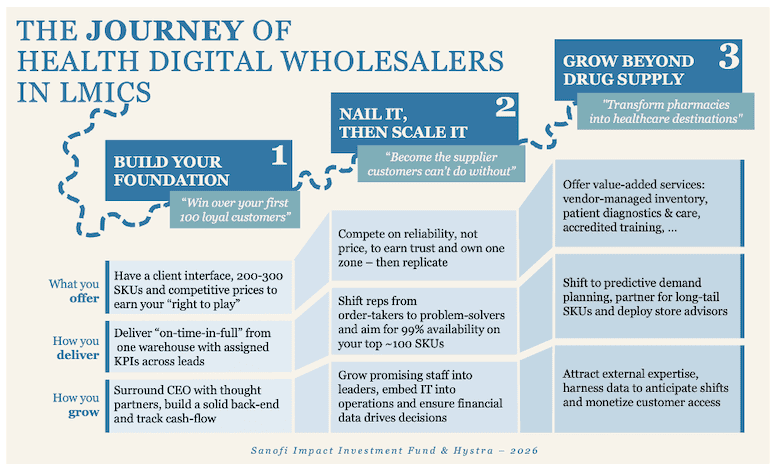
This tool outlines key priorities and performance targets across the digital wholesaler business model (including areas like the value proposition, operational model, financial and IT model, and team) tailored to each stage of a venture’s maturity.
The journey is split into three stages of maturity, which should be mastered sequentially to ensure that no capital is wasted, and that staff know where to focus:
- Stage 1: Build Your Foundation. Prove that your value proposition has traction by winning over 100+ repeat customers, thereby confirming your “right to play” in this business space. Here, the goal is to establish a minimal value proposition, with a small but repeat customer base. For example, at this stage, a venture is expected to have a client interface working and 200-300 SKUs in stock to confirm traction.
- Stage 2: Nail it, Then Scale it. Consolidate for profitability, becoming a trusted wholesaler for a customer segment in a given geography thanks to deepened relationships and high reliability (i.e., aiming to achieve 99% availability for your top 100 SKUs). Then scale to new geographies/segments while maintaining service quality and product availability, with the goal of deepening your share of your pharmacy clients’ merchandise to up to 70-80% (ideally).
- Stage 3: Grow Beyond Drug Supply. Develop innovative services that help private points of care transform their operations and serve their communities better. For example, these services could help pharmacists better manage their inventory, validate their licenses (a difficult task in some LMIC markets), or broaden the services they offer to patients (e.g., adding diagnostic services to their existing offerings).
Our ambition in codifying this knowledge was threefold:
- First, to give CEOs a cost-effective way to assess where they stand and prioritize the goals they must accomplish to grow their businesses, by making actionable operational insights directly accessible to them and their team.
- Second, to conduct diagnostics in parallel to our due diligence, translating findings into a Value Creation Plan co-developed with the venture. This ensures that TA funds go towards the areas they are most needed.
- Third, to foster knowledge-sharing across the broader ecosystem of practitioners.
Since its inception, this tool, tested with several portfolio companies as part of a diagnostic exercise, has proven to be valuable. It has helped not only ourselves as investors, but also the companies and their top management to align on which of the three stages of maturity the enterprise is at — a key prerequisite to seeking alignment on strategic priorities. When using the tool with these portfolio companies, we often started by identifying unsuspected misalignment on maturity among top management, which needs to be solved before moving forward.
For example, when running the tool with top management teams, we realized that some initially did not agree on how well they were segmenting customers, or how well their sales teams were delivering the sales pitch. These leaders also realized that some of their planned initiatives — e.g., geographic expansion, warehouse openings, and complex technology features or product importation — were premature. They needed to focus on the fundamentals first: from improving customer segmentation to ensuring reliable availability for their top 100 products. These were not the most exciting priorities, but they were the right ones for their stage of growth.
This tool continues to evolve, and we expect it to grow in line with experience and external contributions, as part of a broader set of solutions developed by the Sanofi Impact Fund. Clarifying the journey of health digital wholesalers is one of many components of the Fund’s TA approach, and we expect the insights generated by these efforts to evolve as we learn more from ventures, co-investors and the ecosystem.
Indeed, this tool was generated from the start with the support of entrepreneurs: Back in 2024, when we first started the codification of our learnings, we organized a peer-learning session between all ventures of the portfolio (at the time), where the more mature ones could reflect back on their journey while the early-stage ones reflected forward. It was a key moment that generated rich insights and helped us refine the tool to match entrepreneurs’ perspectives.
If you are keen to learn more about this topic, or interested in contributing, we’d love to continue the conversation and share the diagnostic tool derived from these insights — a ready-to-deploy methodology delivered through 3-5 day in-person operational assessments. Feel free to reach out to the Sanofi Impact Fund (via Laura Collet, Head of Sanofi Impact Fund) or Hystra teams (via Alice Magand, Project Manager).
François Lepicard is a Senior Partner, Alice Magand is a Project Manager and Guillaume Massot is a Project Manager at Hystra; Laura Collet leads the Global Health Unit Impact Fund at Sanofi.
Photo credit: PeopleImages
You May Also Be Interested In:



- Categories
- Health Care, Investing